
How Indian Doctors Can Start the Licensing Process in Germany: Approbation Step-by-Step Guide

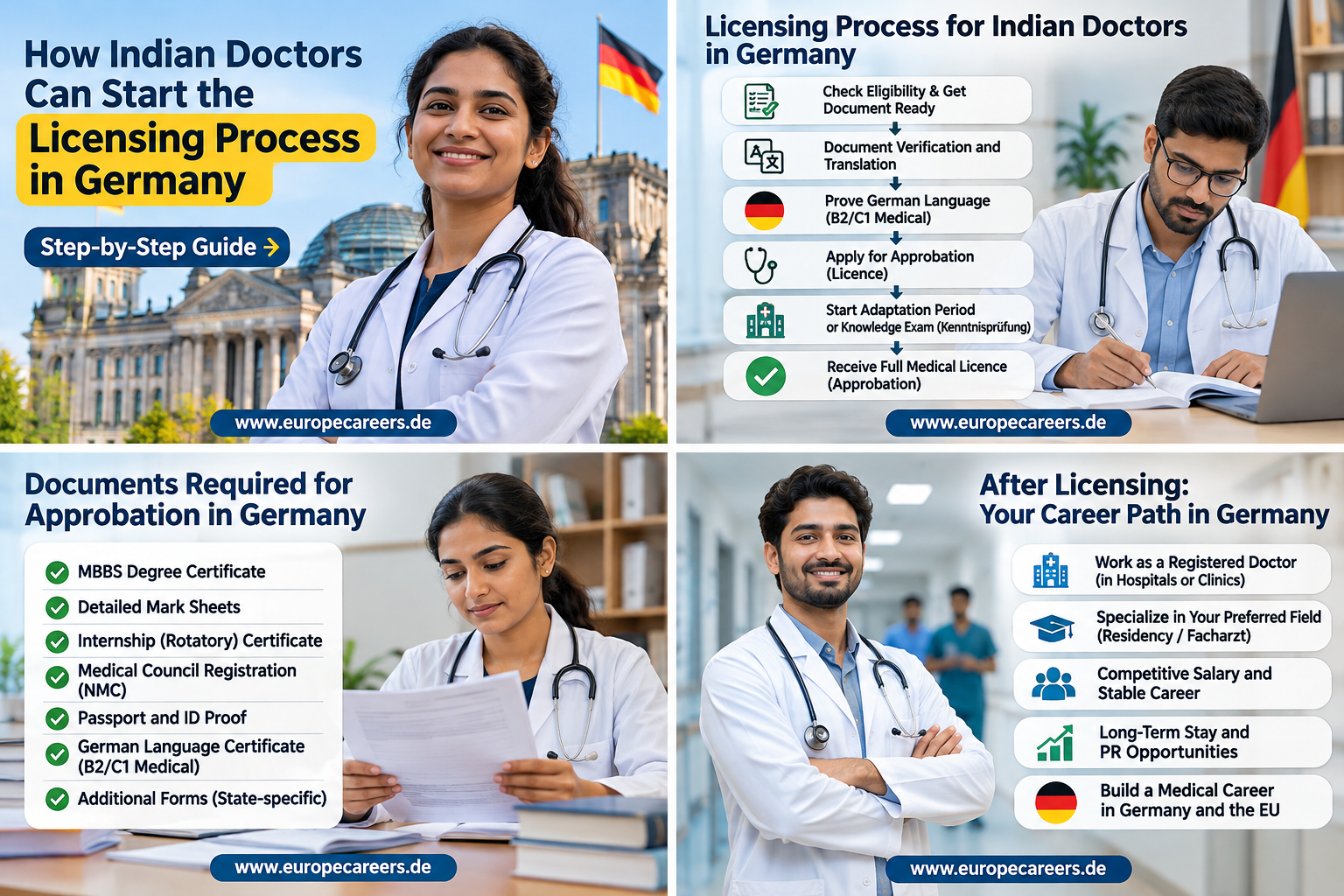
How can an Indian MBBS doctor start the medical licensing process in Germany? The answer begins with a term you will hear repeatedly: Approbation. This is Germany’s full medical licence, and obtaining it involves more than securing a hospital interview or translating an MBBS certificate.
If you completed your MBBS and internship in India, you may be wondering whether you must travel to Germany first, which state to choose, whether B2 German is enough, what the Fachsprachprüfung (FSP) and Kenntnisprüfung (KP) mean, and what happens while your qualifications are being assessed. This guide walks through these questions step by step.
It focuses on real preparation: eligibility, state licensing authorities, document checklists, medical German, qualification assessment, examinations, costs, temporary work permissions and possible immigration routes. Procedures can vary by state and change over time; the relevant authority’s current instructions govern each application.
At a glance: Indian doctors generally need Approbation for unrestricted medical practice in Germany • German B2 and medical-language competence around C1 are commonly required • The state authority assesses qualifications • A knowledge examination may be necessary • Berufserlaubnis, when available, is limited and temporary • A job offer or visa does not replace professional licensing.
What does medical licensing in Germany mean?
An MBBS degree from India is an important professional qualification, but it does not by itself authorise unrestricted medical practice in Germany. Medicine is a regulated profession. To practise independently within the scope of the profession, you generally need Approbation, Germany’s full medical licence, granted by the competent authority.
The licensing journey considers whether your medical education meets the relevant requirements, whether you have adequate German language ability, and whether you meet health, reliability and other professional conditions. The competent authority—not a recruitment consultant or hospital—makes the licensing decision.
A doctor may hear that “Germany needs doctors” and assume that an employment offer is the only missing step. In reality, a hospital’s willingness to consider you and the authority’s permission for you to practise are separate matters. Both require careful planning.
Approbation vs Berufserlaubnis: Know the difference
| Feature | Approbation | Berufserlaubnis |
|---|---|---|
| Meaning | Full authorisation to practise medicine in Germany | Temporary, limited professional permission under specified conditions |
| Scope | Generally nationwide and not restricted to one employer by the licence itself | May be restricted by activities, location, employer or supervision |
| Typical validity | Normally without a fixed expiry date | Time-limited under applicable rules |
| Qualifications | Recognition/equivalence or the required examination pathway plus other conditions | Eligibility set by the particular authority and legal route |
| Replacement for full licence? | This is the full licence | No; it is not the same as Approbation |
Some international graduates may qualify for a Berufserlaubnis while working toward Approbation, but it is not guaranteed, and its practical conditions vary. Do not assume you can begin treating patients on a tourist visa or simply because a hospital has interviewed you.
A practical licensing roadmap for Indian MBBS graduates
| Stage | What you should do | Likely output |
|---|---|---|
| Choose federal state | Identify where you intend to work and the responsible licensing authority | Correct state-specific instructions |
| Check eligibility | Review MBBS, internship, professional registration and personal conditions | Initial document plan |
| Prepare papers | Collect, translate and certify documents as requested | Application-ready file |
| Build German | Prepare general German and clinical communication | Language evidence and FSP readiness |
| Submit Approbation application | File with the competent authority and pay applicable fees | Acknowledgement and document review |
| Qualification assessment | Authority examines comparability of medical training or applicable assessment route | Recognition decision or further examination requirement |
| Pass required examinations | Complete FSP and, where applicable, Kenntnisprüfung | Evidence needed for licensing |
| Receive licence | Meet all remaining requirements | Approbation decision |
| Find qualified employment | Apply to hospitals with correct licence/work status | Employment and immigration steps as applicable |
You can begin researching and assembling your application from India. Whether an authority accepts an application from outside Germany, what evidence of intent to work it requires, and whether an employer offer is necessary in a particular step depend on the state’s rules.
Which authority handles the Approbation application?
Germany does not have one single licensing counter that processes every Indian doctor’s application. The competent authority of the relevant federal state is responsible. This means the forms, documents, fees, communication method and sequence of examinations may differ depending on the state you choose.
Choose the state based on a realistic work plan rather than social media claims about the “easiest state.” Compare employer opportunities, the authority’s requirements, language-examination arrangements and the evidence you can provide showing your intention to practise there.
Changing states after submitting documents can complicate communication and may require additional administration. Ask the authorities before filing duplicate applications. Berlin, Bavaria, North Rhine-Westphalia and other states may have different administrative procedures, even though the core legal objective is the same: licensing a competent doctor.
Eligibility and qualifications for Indian doctors
| Requirement | What it generally involves |
|---|---|
| Medical qualification | MBBS degree and complete academic training records |
| Practical medical training | Rotatory internship or clinical training evidence, where relevant |
| Professional standing | Indian medical registration/licensing and evidence of good standing when requested |
| German communication | Usually B2 general German plus medical-language competency around C1 |
| Medical knowledge | Qualification equivalence or a required knowledge assessment |
| Good character | Police clearance or professional reliability evidence as specified |
| Health suitability | Relevant medical fitness declaration or certificate |
| Intention to work | Evidence of planned professional activity in the selected state, where requested |
Every profile is different. An applicant whose degree was awarded abroad, who has changed professional registration, or whose internship evidence is incomplete should request clarification from the relevant authority early. An additional postgraduate qualification may be useful professionally, but it does not automatically remove basic Approbation requirements.
Documents required for Approbation: A detailed checklist
| Document | Why it matters | Preparation note |
|---|---|---|
| Passport and identity records | Establish identity and nationality | Check spelling consistency |
| MBBS degree certificate | Proves medical qualification | Follow translation/certification instructions |
| Detailed mark sheets | Show examination and course record | Keep clear year-wise copies |
| Course curriculum and hours | Help evaluate training content and duration | Request official detailed syllabus where needed |
| Internship completion certificate | Records required clinical training | Check exact dates and rotations |
| Professional registration | Evidence of eligibility to practise in India | Follow state/NMC records applicable to you |
| Certificate of good standing | Shows professional standing | Often subject to recency requirements |
| CV and employment history | Explains training, work and any gaps | Use accurate chronological dates |
| Experience certificates | Support professional history | Include duties and dates when available |
| German B2 certificate | General language evidence | Use accepted examination format |
| Medical-language examination evidence | Assesses clinical German | FSP process usually coordinated by the state |
| Police-clearance document | Professional reliability | May need a recent certificate |
| Medical fitness certificate | Fitness to practise | Check form and recency rules |
| Birth/marriage/name-change papers | Resolve differing names when applicable | Only where relevant |
| State application forms and declarations | Formal request and legal statements | Use the current authority-issued forms |
| Evidence of intention to work | May establish jurisdiction | Check state-specific rules |
The precise list can change. Never send expensive originals or pay for apostilles, certifications or translations until you know what the competent authority will accept. Some documents have limited validity, so ordering them too early may mean obtaining them again.
Translation, certification and document verification
Many applicants lose time not because they lack a qualification but because a document is incomplete or submitted in the wrong format. Authorities may require certified copies, translations by accepted translators and, in certain situations, further authenticity checks.
Keep a master checklist with columns for the document name, issuing institution, original available, translation status, certification status, date issued and submission date. Make sure your name appears consistently on the passport, degree, internship letter and registration records. If a spelling differs, gather legitimate supporting evidence rather than altering a record.
Contact your medical college or university early for a detailed curriculum and proof of training hours if your state authority requests them. These records can sometimes take longer to collect than a simple degree certificate.
German language: Why B2 and medical C1 both matter
A doctor needs more than conversational German. You may be asked to take a patient’s history, explain a diagnosis without unnecessary technical language, discuss consent, write a medical report and hand over a case to colleagues.
| Skill | Typical expectation | Why it matters |
|---|---|---|
| General German | Usually B2 | Everyday professional communication and understanding |
| Medical German | Typically C1-level professional-language competence | Patient conversations, documentation and clinical handovers |
| Fachsprachprüfung (FSP) | Medical-language examination or equivalent as required | Demonstrates practical professional communication |
| Workplace language | Continues improving after qualification | Supports safe, effective teamwork |
Some states or individual cases have their own accepted language evidence and examination procedures. A language-school attendance letter is not automatically equivalent to a recognised certificate or FSP pass.
Explore German language courses A1–B2 as an initial pathway, while planning separately for professional medical German.

What happens during the Fachsprachprüfung (FSP)?
The Fachsprachprüfung assesses medical communication rather than simply memorised vocabulary. The actual examination provider and format are determined by the relevant state. A common structure includes patient communication, written medical documentation and a professional handover or doctor-to-doctor discussion.
| Common FSP component | Skills tested | How to prepare |
|---|---|---|
| Patient interview | History taking, empathy, follow-up questions | Practise structured anamnesis aloud |
| Written documentation | Clear, accurate clinical notes or a report | Write brief case summaries and get corrections |
| Doctor-to-doctor handover | Communicating findings using appropriate technical language | Practise presenting a case logically |
For an international graduate, the biggest challenge may be changing between plain language with a patient and precise medical terminology with another doctor. Practise both. A clinically knowledgeable applicant can still struggle if they misunderstand a question or cannot explain information clearly.
Read our FSP guide for Indian doctors for additional preparation context.
How Germany assesses whether an Indian MBBS is equivalent
The licensing authority reviews the medical education received abroad against the German framework and applicable laws. This can include the structure, duration, clinical subjects and practical components of the programme. Some applicants may be asked for detailed syllabuses and training-hour evidence.
Where the authority determines that significant differences cannot be sufficiently addressed under the relevant legal assessment, an applicant may be required to pass the Kenntnisprüfung (knowledge examination). The exact assessment pathway can change under current federal and state rules, so rely on the authority’s written decision instead of assumptions that every MBBS graduate has exactly the same route.
In particular, state procedures and the handling of equivalence documentation have evolved. Before selecting an assessment route or paying for professional translations of an extensive curriculum, confirm what your competent authority currently requires.
Kenntnisprüfung (KP): What Indian doctors need to know
The Kenntnisprüfung tests whether a candidate has the medical knowledge necessary for the German licensing standard. It is not merely a general German test. It is a clinical assessment, commonly centred on internal medicine and surgery while potentially covering related areas such as emergency care, pharmacology, imaging interpretation and professional legal obligations.
| Preparation area | Focus |
|---|---|
| Internal medicine | Clinical reasoning, common conditions and management |
| Surgery | Surgical assessment, urgent situations and safe decision-making |
| Diagnostics | History, examination, laboratory results and imaging |
| Emergency care | Recognising red flags and initial management |
| Pharmacology | Medication choices, interactions and patient safety |
| Medical law and communication | Consent, confidentiality, documentation and professional duties |
The examination format, scheduling and repeat rules must be checked with the responsible body. Passing a medical-language examination does not automatically mean the knowledge examination is waived. Equally, being a specialist in India does not automatically remove the examination requirement for the basic licence.
Explore Kenntnisprüfung preparation for further detail.
Do all Indian doctors have to take the Kenntnisprüfung?
No single answer is appropriate for everyone. A non-EU medical qualification must be assessed under the applicable regulations; the route may include document-based equivalence assessment and, where required, a knowledge examination. Whether the exam applies depends on the authority’s assessment, current procedures and individual circumstances.
Avoid two opposing myths: “Every Indian doctor automatically gets Approbation after B2,” and “Every Indian doctor must always sit exactly the same exam regardless of their documents.” Neither is a reliable universal statement. Your written licensing decision is the key document.
Can you work with Berufserlaubnis before full Approbation?
Some doctors may be eligible for temporary Berufserlaubnis while progressing toward full licensing. Its legal scope can be limited and may involve specific activities, locations or supervision. An employer cannot simply decide to grant it; the relevant authority does.
Before accepting any hospital position, ask whether Approbation is required at the start date, whether the employer supports a Berufserlaubnis application, what clinical responsibilities would be permitted and how the job would be paid. Get the working arrangements in writing.
Be particularly careful with advertisements that promise “doctor work without Approbation” without explaining which legal permission authorises the duties involved.
Applying from India: What to do first
You do not have to begin with a flight ticket. Most applicants can make substantial progress from India by understanding the process, selecting a state, preparing German and compiling documents. The ability to submit a complete application from abroad and the proof required by a particular authority depend on the relevant state.
| Priority | Action to take in India |
|---|---|
| Understand your goal | Decide whether you are seeking full medical practice or a different healthcare career |
| Choose a German state | Read the current Approbation requirements of the authority |
| Prepare language | Plan general German B2 and medical communication |
| Request university records | Gather degree, mark sheets, internship and curriculum |
| Confirm professional standing | Check registration and good-standing document requirements |
| Arrange accepted translations | Follow the authority’s precise format |
| Submit appropriately | Use the authority’s accepted application channel |
| Plan later steps | Budget for FSP, KP if needed, visa and relocation |
It may be sensible to apply to hospitals while recognition is in progress, but be clear about your current professional permissions. A hospital inquiry is not a licence, and an Approbation application is not a visa.
Visa pathways while medical recognition is pending
Professional licensing and immigration are separate legal processes. A doctor may need a suitable visa or residence route for recognition measures, medical-language preparation, supervised professional activity or qualified employment, depending on the stage and case.
Do not assume an Opportunity Card, visitor visa or any national visa automatically grants the right to practise medicine. In regulated healthcare occupations, permission to work in a particular clinical role can depend on both residence authorisation and professional licensing.
Before applying for a visa, check the correct category for your actual purpose and the employer or recognition documents needed. See our Germany Work Visa guide for broader immigration context.
How long does medical licensing take?
There is no honest single timeline that applies to all Indian doctors. The duration depends on German language preparation, the availability of university records, the licensing authority, whether the file is complete, FSP scheduling and whether a Kenntnisprüfung is required.
| Process stage | What can affect the duration |
|---|---|
| Document preparation | University response times, translations and certifications |
| German B2 | Starting level and weekly study commitment |
| Medical-language preparation | Clinical communication ability and exam availability |
| Authority review | Completeness of file, workload and assessment requirements |
| Knowledge exam if required | Availability of exam dates and preparation |
| Residence / relocation | Visa procedure, employer onboarding and housing |
When assessing advertisements promising a medical licence within a fixed number of weeks, ask exactly which stages are included and which are excluded. Language preparation alone may take months, and examination scheduling is not fully within an applicant’s control.
Costs of Approbation: Build a realistic budget
The total cost is not one fixed government fee. It can include licensing application charges, sworn translations, certified copies, university documents, language courses, examination fees, medical or police certificates, travel, visa costs and living expenses if you relocate before finishing.
| Cost category | Planning advice |
|---|---|
| Licensing authority fee | Check the selected state’s current fee schedule |
| Translation and certification | Obtain quotes after confirming accepted formats |
| German language courses | Budget separately for B2 and medical-language study |
| FSP and KP exams | Check examination fees and any repeat costs |
| Documents from India | Allow for university records and professional standing certificates |
| Visa and insurance | Match the exact route and start date |
| Relocation | Budget for accommodation deposits and initial living costs |
Some employer or public support programmes may be available in individual cases, but never assume an organisation will automatically reimburse expenses. Ask what is covered, when it is paid and whether any repayment conditions apply.
After Approbation: Employment and specialisation
Approbation opens the door to legally practising medicine under the applicable professional rules. It does not guarantee a job, a particular salary or recognition as a German specialist. You must still apply to employers and satisfy the requirements of the position.
A common hospital employment title is Assistenzarzt/Assistenzärztin, often associated with specialist training. A doctor seeking recognition of a postgraduate specialty obtained in India must investigate that separately with the relevant authority or medical chamber. Full basic medical licensing and specialist recognition are distinct processes.
For compensation information, read our Arzt Salary in Germany guide. Salaries depend on position, experience, collective agreement, employer and duties.
Common mistakes Indian MBBS doctors should avoid
- Starting translations before checking the state checklist: You may pay twice for the wrong format.
- Assuming one state’s process applies everywhere: Administrative methods differ.
- Confusing FSP with KP: Language and medical knowledge are assessed separately.
- Believing an employer can issue Approbation: Only the competent authority grants the licence.
- Submitting incomplete university records: Missing curriculum or internship evidence can delay review.
- Relying on B2 alone for clinical work: Medical communication requirements remain important.
- Confusing specialist recognition with basic licensing: They are separate evaluations.
- Making non-refundable relocation payments too early: Visa and licensing decisions may take time.
- Trusting guaranteed-approval claims: Neither consultants nor recruiters control official decisions.
Frequently asked questions about medical licensing in Germany
Can an Indian MBBS doctor apply for Approbation?
Yes, doctors with medical qualifications from India can pursue the German licensing process, provided they meet the relevant legal, professional, language and other requirements.
Can I start the application while living in India?
Many preparatory steps can be completed from India, and application options depend on the selected state’s authority. Confirm the rules for submitting from abroad and any required evidence of intention to practise there.
Is German B2 enough to work as a doctor?
Usually not by itself. Medical professional language competency, often assessed through an FSP at approximately C1 medical level, and the relevant licence are also important.
What is the difference between Approbation and Berufserlaubnis?
Approbation is the full medical licence. Berufserlaubnis is a possible time-limited professional permission with specified restrictions.
Does every Indian doctor need the Kenntnisprüfung?
It depends on the qualification assessment and current legal procedure. Follow the competent authority’s individual decision.
Can I choose any German federal state?
You normally apply to the authority connected to your intended professional activity. Jurisdiction and evidence requirements should be checked before filing.
Do I need a hospital job offer before applying?
Not in every case, but authorities may require proof of intention to practise in their jurisdiction, and certain visa or temporary-permission routes can require an employer.
Does an Indian MD or MS automatically count as German Facharzt recognition?
No. Specialist training recognition is evaluated separately under the applicable professional rules.
Can I work on a tourist visa while waiting for Approbation?
No. Ordinary medical employment requires the appropriate professional and immigration permissions.
How much does medical licensing cost?
Costs vary by authority, document needs, language training, examinations and relocation plans. Request current fees rather than relying on a universal package amount.
Can the licensing authority ask for additional documents?
Yes. It may request missing, updated or more detailed evidence during the assessment.
How long does the process take?
There is no guaranteed duration. Language preparation, document completeness, assessment and examination scheduling can all change the timeline.
What happens after I obtain Approbation?
You can pursue appropriate medical roles, subject to immigration and employer requirements. Specialist training or recognition may require further steps.
Can I pursue this route without a consultant?
Yes. Applicants can contact the responsible licensing authority and follow the process themselves. Professional guidance can be useful, but it is not a substitute for official decisions.
Start with the right plan, not a licensing promise
For an Indian doctor, moving toward medical practice in Germany is a serious professional project. It requires attention to qualifications, documentation, German communication, legal permission and often several assessments. The first useful step is to identify the competent state authority and understand the requirements for your own MBBS and professional history.
At Europe Careers, we help applicants explore German language preparation, healthcare career pathways and the documentation steps that may be involved. Learn more through our Doctors Jobs in Germany page or contact the Europe Careers team to discuss your background. Licensing decisions are made by German authorities; employment and visas follow their separate requirements.


[…] our Indian doctors’ licensing guide and healthcare opportunities beyond Germany for detailed profession-specific […]
[…] Careers provides guidance on German language preparation and medical career pathways. Explore our Approbation guide for Indian doctors, doctor career information, German language courses A1–B2 and contact Europe Careers for […]
[…] Indian medical professionals explore German-language preparation and recognition pathways. Read our Approbation guide for Indian doctors, doctors’ jobs in Germany service page, MBBS without NEET PG guide, and contact Europe […]
[…] For related guidance, read How Indian Doctors Can Start the Licensing Process in Germany. […]