
Europe’s New Talent Pool Could Open Doors to International Careers: What Indian Professionals Can Expect in 2027

Updated November 2026 • Outlook for Indian professionals planning international careers in 2027
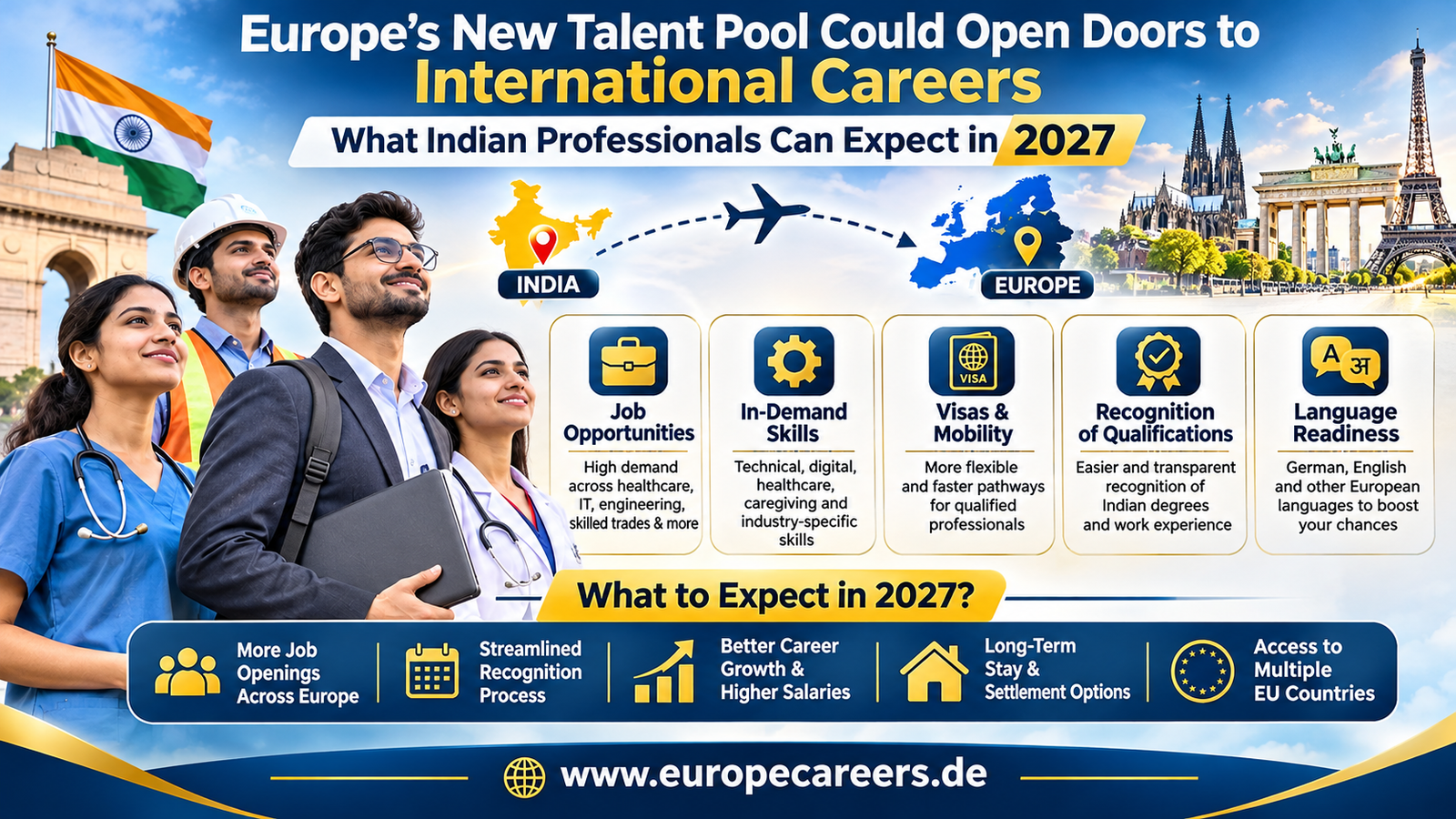
Could a new European recruitment platform make it easier for Indian professionals to find international jobs in 2027? The European Union’s Talent Pool initiative aims to connect employers facing skills shortages with qualified jobseekers living outside the EU. For Indian engineers, healthcare professionals, IT specialists and skilled workers, that could eventually make cross-border job opportunities more visible.
But there is an important difference between a promising recruitment initiative and a guaranteed route to Europe. The EU Talent Pool does not itself issue visas or recognise degrees. Its final operation and participating countries must be confirmed before applicants rely on it.
This detailed guide explains Europe’s new Talent Pool, what Indian professionals could expect in 2027, likely career areas, eligibility preparation, professional recognition, language requirements, salary considerations and how to avoid misleading recruitment promises.
Key takeaway: The EU Talent Pool could improve access to international vacancies in participating countries, but it is not an automatic job, visa, licence or permanent-residence programme. Prepare your qualifications, language skills and documents while monitoring the actual rollout.
What Is the EU Talent Pool?
The EU Talent Pool is a proposed European Union initiative to help employers in participating EU member states connect with jobseekers from countries outside the EU. The idea is to provide a voluntary, EU-level platform where international candidates can present their skills and employers can identify people for occupations facing labour shortages.
It is important to understand the difference between a talent-matching platform and an immigration programme. The Talent Pool is intended to support recruitment; it does not itself issue work visas, grant professional licences or guarantee employment. A successful match would still need to satisfy the destination country’s immigration, employment and professional rules.
The initiative was proposed by the European Commission in November 2023 and progressed through the EU legislative process. For Indian candidates looking toward 2027, its final rules, participating countries and operational launch arrangements must be checked before treating the platform as an available application service.
Why This Matters for Indian Professionals
Many Indian professionals have qualifications and work experience relevant to European employers, but finding credible vacancies abroad can be difficult. Candidates may struggle to identify which countries are recruiting, what qualifications are recognised and whether an employer will consider applicants who live outside Europe.
A common matching platform could make some opportunities easier to discover, particularly where participating employers are willing to recruit internationally. That does not remove competition. Employers would still compare qualifications, experience, language ability and availability.
For a nurse, an engineer or a skilled technician, the useful question is not merely “Will Europe hire Indians?” It is “Which participating employer needs my actual skills, and what must I complete before I can legally take the job?”
What Indian Applicants Could Expect in 2027
| Potential development | What it could mean | What is not guaranteed |
|---|---|---|
| EU-level candidate profiles | A place to present qualifications and work experience | An interview or offer |
| Participating employers | More visible vacancies from employers using the system | Participation by every EU country |
| Shortage occupations | Matching focused on labour-market needs | Eligibility for every profession |
| Information about requirements | Better guidance about jobs and immigration pathways | Automatic visa approval |
| Recruitment support | Possibly clearer international recruitment procedures | Waiver of language or licence rules |
| Qualification information | More transparent information about recognition | Automatic acceptance of Indian qualifications |
These are possible benefits based on the initiative’s intended design. The exact services available in 2027 depend on implementation. Candidates should avoid advertisements promising guaranteed EU Talent Pool selection or a single EU-wide work permit.
Which European Countries Could Participate?
The proposed Talent Pool is voluntary for EU member states. That means not every EU country is automatically required to participate. The final list of participating countries matters because employers in non-participating states may not be accessible through the platform.
Germany, Austria, the Netherlands and other European destinations already have their own national recruitment and immigration systems. The Talent Pool should not be confused with those existing systems or treated as a replacement for them.
The United Kingdom, Norway and Switzerland are not EU member states. Their separate immigration and recruitment systems should not be represented as automatically covered by an EU member-state Talent Pool.
Which Careers Might Benefit?
| Career field | Examples to research | Important condition |
|---|---|---|
| Healthcare | Nursing, medicine, allied health | Professional licensing and local language may be mandatory |
| Engineering | Mechanical, electrical, civil and industrial roles | Relevant qualification and employer criteria |
| IT and digital | Software, cybersecurity, infrastructure and data | Demonstrable technical skills and suitable offers |
| Skilled trades | Technical maintenance, electrical and industrial occupations | Formal training or recognition may be required |
| Hospitality | Qualified hospitality and food-service roles | Actual shortage occupation and employer participation |
| Logistics and manufacturing | Specialised technical or operational positions | Job duties and national immigration eligibility |
This is a list of sectors to investigate, not a confirmed final Talent Pool occupation list. The scheme is intended to focus on shortage occupations, with the precise scope determined by the adopted rules and participating countries.
Will Indian Nurses and Doctors Be Eligible?
Healthcare recruitment is one of the areas many international applicants watch closely. However, a European employer’s interest in an Indian nurse or doctor does not remove the destination’s legal licensing process.
Doctors seeking to practise in Germany generally need Approbation, while nurses face recognition and registration requirements. Other EU countries have their own regulators, language examinations and professional rules. A Talent Pool match may help identify a potential employer but cannot independently authorise clinical practice.
Read our Indian doctors’ licensing guide and healthcare opportunities beyond Germany for detailed profession-specific planning.
How the EU Talent Pool Could Work
| Possible stage | Candidate action | Employer or authority role |
|---|---|---|
| Create profile | Enter education, skills and work history | Platform makes eligible information discoverable |
| Identify vacancies | Search roles in participating countries | Employers publish qualifying openings |
| Match and communicate | Respond to suitable opportunities | Employer evaluates the candidate |
| Interview | Explain experience, language and availability | Employer assesses suitability |
| Qualification checks | Provide diplomas and professional evidence | Competent bodies assess recognition where required |
| Employment offer | Review contract and working conditions | Employer issues a genuine offer |
| Work authorisation | Apply under destination country’s rules | National authorities decide visa/residence permission |
| Relocation | Prepare housing and arrival requirements | Employer onboards successful candidate |
This illustrates the intended recruitment journey, not a confirmed set of live portal screens or an official step-by-step procedure for 2027. Applicants should wait for operational instructions before submitting sensitive documents to websites claiming to be the Talent Pool.
Eligibility: What Indian Professionals Should Prepare
Because the EU Talent Pool is a recruitment initiative rather than one universal work visa, there is no responsible single eligibility checklist that guarantees entry into every European country. The final platform conditions, advertised occupation and national work-permit requirements will all matter.
| Area | Preparation advice |
|---|---|
| Education | Keep your recognised degree, diploma and transcripts ready |
| Experience | Document duties, dates and genuine references |
| Languages | Check English or the destination’s national language |
| Occupation | Understand whether your profession is regulated |
| CV | Use a clear European-style CV tailored to each vacancy |
| Professional registration | Check national licensing requirements early |
| Passport | Maintain valid identity documentation |
| Immigration | Research the actual destination country’s work-permit route |
Applicants should never claim a qualification or certificate they do not hold. In regulated healthcare and technical professions, inconsistent records can cause significant delays.
Language Requirements Across Europe
There is no single language requirement that applies to all European jobs. English may be sufficient for some international technology or business roles, while German, Dutch, Swedish or another national language may be essential in healthcare, customer service and safety-critical work.
| Destination | Language planning |
|---|---|
| Germany | German can be essential for healthcare, trades and many local roles |
| Austria | German is important in regulated and customer-facing professions |
| Netherlands | Dutch is generally essential for regulated clinical practice |
| Sweden | Swedish is important for healthcare licensing and many public-facing jobs |
| Ireland | English proficiency and regulator-specific evidence may be required |
| France | French can be central to professional communication and licensing |
Start with the actual job advertisement and professional regulator. A platform match does not replace an employer’s language expectations.
Does the Talent Pool Provide a Visa?
No automatic EU work visa should be assumed. The Talent Pool is designed to help connect candidates with employers. Immigration remains governed by applicable EU and national rules. Depending on the job and country, a candidate might explore a national skilled-worker permit, EU Blue Card or another eligible route.
A job offer is also not the same as visa approval. The applicant must satisfy the relevant conditions, and the competent authority makes the immigration decision.
Indian applicants should check whether the employer can support the relevant route, whether the offered salary meets applicable rules and whether the profession requires licensing before work begins.
Will Qualification Recognition Become Easier?
The EU Talent Pool could make information about recognition easier to find, but it is not designed to automatically recognise every non-EU diploma. Recognition is still determined by the appropriate national authority or professional regulator.
For instance, an Indian engineer with a comparable university degree and an Indian nurse seeking protected professional registration face very different processes. A doctor may need language and knowledge examinations, while some unregulated IT roles may not involve the same professional licensing system.
Germany already offers a Recognition Partnership pathway for certain eligible workers. That is a distinct national immigration route and should not be presented as the same programme as the EU Talent Pool.
How to Find Genuine European Employers
International recruitment requires caution. A professional website and attractive salary graphic do not prove that an employer is genuine. Verify the legal company name, vacancy location, employment terms and recruiter identity before sharing sensitive documents.
Do not pay for a “guaranteed EU Talent Pool slot.” No genuine recruiter can promise that an employer will hire you or that immigration authorities will approve a permit. Keep copies of agreements and ask who is responsible for recruitment fees, travel and any recognition expenses.
If a purported portal requests payment before showing basic programme rules, or claims to offer one visa for all of Europe, treat the claim as a warning sign.
EU Talent Pool vs Germany’s Opportunity Card
| Feature | EU Talent Pool concept | Germany Opportunity Card |
|---|---|---|
| Main purpose | Connect non-EU jobseekers with employers in participating EU states | Enable eligible applicants to search for work in Germany |
| Geographic scope | Participating EU member states | Germany |
| Job offer at start | Platform matching may begin before a job offer | Not always required under qualifying eligibility routes |
| Visa included? | No automatic EU-wide work visa | A German residence/visa category with its own conditions |
| Recognition | National rules still apply | Separate qualification and regulated-profession requirements |
| Status | Implementation and country participation must be checked | Existing German immigration pathway |
EU Talent Pool vs EU Blue Card
The EU Blue Card is a residence and employment framework for eligible highly qualified non-EU workers, subject to national implementation and qualifying employment conditions. The Talent Pool is intended to help people find suitable employers. One is a recruitment mechanism; the other is a legal residence pathway.
A person who finds a qualifying job through an eventual Talent Pool service may still need to apply for a Blue Card or another appropriate national permit. The platform itself does not create automatic eligibility for the Blue Card.
Salary Expectations for 2027
There is no single “EU Talent Pool salary.” Actual compensation will depend on the occupation, country, employer, experience, working hours and collective agreements. A nurse in Ireland, a software engineer in Germany and a technician in Austria cannot be compared using one headline figure.
| Salary factor | Why it matters |
|---|---|
| Gross pay | Contracted salary before deductions |
| Taxes and insurance | Affect take-home income |
| Housing | Major expense in some European cities |
| Overtime and shifts | May change actual earnings |
| Professional level | Junior and senior roles have different pay scales |
| Relocation costs | Visa, travel and deposits reduce initial savings |
| Family circumstances | Change expenses and residence planning |
Ask employers for the specific gross salary and employment conditions. Be cautious about advertisements that promise identical pay for every applicant regardless of country and role.
How Indian Professionals Can Prepare Before 2027
| Time frame | Recommended action |
|---|---|
| Now | Choose one or two realistic destination countries and occupations |
| Next month | Update CV and collect degree, transcripts and experience letters |
| Following months | Begin relevant language preparation |
| Before applications | Check qualification recognition and licensing |
| When the platform is operational | Use only confirmed official registration channels |
| After a genuine match | Review employer, contract and national visa rules |
| Before departure | Arrange accommodation, insurance and relocation budget |
The strongest preparation is useful even if the Talent Pool’s operational timetable changes. Genuine qualifications, language ability, accurate records and a targeted CV also support existing national recruitment routes.
Common Mistakes to Avoid
- Assuming the EU Talent Pool is a visa: It is intended as a matching initiative, not an immigration approval.
- Believing every EU country must join: Member-state participation is voluntary.
- Assuming Indian degrees are automatically recognised: National rules still apply.
- Ignoring language requirements: Clinical and customer-facing roles often need local-language skills.
- Applying for every profession: Focus on genuine qualification and experience matches.
- Paying for guaranteed selection: Employer decisions and immigration approvals cannot be purchased.
- Confusing a proposal with an operational portal: Confirm the actual legal and launch status before applying.
Frequently Asked Questions
What is the EU Talent Pool?
It is an EU initiative intended to connect jobseekers from outside the EU with employers in participating EU member states, particularly for shortage occupations.
Can Indian professionals use the EU Talent Pool in 2027?
They may be able to if the platform is operational, they meet the final rules and the relevant member state participates. The launch arrangements should be verified before applying.
Is the Talent Pool only for Indians?
No. It is intended for eligible jobseekers from countries outside the EU more broadly.
Will registration guarantee a job?
No. Employers will still decide whom to interview and hire.
Is an EU Talent Pool visa available?
The Talent Pool itself does not grant a visa. Applicants need the appropriate national immigration authorisation.
Can nurses apply?
Potentially for suitable vacancies, subject to the programme’s final scope and the destination’s nursing registration rules.
Can doctors work without licensing?
No. Regulated medical practice requires the appropriate national professional authorisation.
Does Germany automatically participate?
Participation is voluntary for EU member states, so applicants must check the confirmed participating-country list.
Do applicants need German?
That depends on the job and country. German is important for many roles in Germany and Austria, while other destinations have different language requirements.
Can fresh graduates apply?
Eligibility will depend on the final platform rules and the requirements of the particular vacancy. Some employers may prefer experience.
Is the Opportunity Card the same as the Talent Pool?
No. The Opportunity Card is a German immigration pathway; the EU Talent Pool is intended as a cross-country recruitment platform.
Can I move freely between European countries after being hired?
No automatic unrestricted right follows from a job match. Residence and professional-practice rights depend on applicable national and EU rules.
What Europe Careers Recommends for 2027
Indian professionals should view the EU Talent Pool as a possible additional route to discover credible employers, not a replacement for skills, languages, professional recognition or immigration requirements. The sensible approach is to prepare for occupations where your qualifications genuinely fit and monitor the programme’s actual rollout.
At Europe Careers, we help candidates understand international career pathways, German language preparation and employment documentation. Explore jobs in Germany, healthcare careers across Europe and contact our team for relevant guidance. Employers, professional regulators and immigration authorities retain responsibility for their own decisions.