Ausbildung vs University: Which Career Path Is Better in Germany?

Ausbildung vs University in Germany: Which one gives you better career opportunities? For Indian students planning to study or build a career in Germany, this is an important decision. One route teaches a profession through practical work; the other leads to an academic degree. Both can lead to skilled employment, but they differ in costs, earnings, admission and future possibilities.
A student who enjoys repairing machines may thrive in technical Ausbildung. Someone who wants to become a researcher or pursue a degree-required profession may need university education. The question is not which option looks more impressive—it is which one fits your goals, academic background, German skills and finances.
Quick answer: Choose Ausbildung if you prefer structured workplace training, a vocational qualification and usually a monthly training allowance. Choose university if your planned career requires an academic degree, research, advanced study or a subject-specific professional qualification. Neither route guarantees admission, a job or permanent residence.
Ausbildung vs University: Quick Comparison
Start with the major differences. Your particular institution, profession and employer may have different arrangements.
| Factor | Ausbildung in Germany | University in Germany |
|---|---|---|
| Main purpose | Train for a recognised occupation | Earn an academic bachelor’s, master’s or other degree |
| Learning style | Workplace practice + vocational classes (dual model) | Lectures, seminars, laboratories, projects and research |
| Typical duration | About 2 to 3.5 years | Bachelor’s often 3–4 years; master’s often 1–2 years |
| Earnings during programme | Usually paid allowance in dual training | No automatic degree salary; eligible student work may be possible |
| Tuition | Dual training normally has no university-style tuition | Many public degrees have no general tuition, but exceptions exist |
| Language | German usually essential; visa normally expects B1 | German- or English-taught courses; meet programme language rules |
| Entry criteria | Training-place offer, education, language and visa conditions | Recognised university-entry qualification, admission and visa conditions |
| Qualification | Recognised vocational qualification | Academic university degree |
| Career orientation | Specific profession and practical responsibilities | Academic, professional, research or specialist careers |
What Is Ausbildung in Germany?
Ausbildung is structured vocational training. In a dual Ausbildung, a company provides paid practical training while a vocational school teaches theory. Depending on the occupation, training usually lasts between two and three and a half years.
Popular areas include nursing, IT systems, mechatronics, electrical engineering trades, hospitality, retail and logistics. Some programmes are school-based, with different financing and salary arrangements; not every Ausbildung pays the same allowance.
Best suited to: People who enjoy learning by doing and want to develop the skills of a recognised occupation.
Learn more through our complete Ausbildung guide for Indian students.

What Is University Study in Germany?
A German university degree follows an academic curriculum. Depending on the subject, it may involve classroom study, laboratories, research, projects, internships and a final thesis. Universities and universities of applied sciences can offer different emphases, including highly practical degrees.
For Indian applicants, university entry depends on whether their educational credentials meet the institution’s requirements. Some candidates may need additional preparation or a foundation route before an undergraduate course. Language and admission criteria are programme-specific.
Best suited to: Students planning a career that requires academic qualifications, advanced technical study, research or a master’s or doctoral degree.
Which Option Costs More?
Ausbildung often means less direct tuition expense and some monthly income. University may have low tuition at many public institutions, but students must still cover living costs. Neither route is entirely free when you consider travel, accommodation, insurance and initial expenses.
| Expense | Ausbildung | University |
|---|---|---|
| Course or tuition charge | Many dual programmes have no tuition; school-based arrangements vary | Many public bachelor’s and master’s degrees have no general tuition; exceptions apply |
| Monthly income | Training allowance in most dual programmes | No standard monthly salary from the university |
| Housing and food | Usually paid by the trainee | Usually paid by the student |
| Semester fees | Vocational-school arrangements vary | Semester contribution normally applies |
| Other costs | Language, visa, travel, deposit and personal expenses | Language, visa, travel, deposit, books and personal expenses |
| Funding proof | Contract allowance plus additional funds where required | Blocked account, scholarship or accepted alternative where required |
Some public universities charge tuition for non-EU students or certain specialised programmes. Private universities and professional master’s courses may be considerably more expensive. Always read the exact tuition and refund terms before paying.
Ausbildung Salary in Germany: What You Can Earn During Training
Dual trainees normally receive a monthly gross training allowance. The amount depends on the profession, employer, collective agreement and year of training. It is not equivalent to the starting salary of a qualified employee.
Germany’s 2027 Statutory Minimum Training Allowance
| Training year | Monthly gross minimum for covered 2027 starters |
|---|---|
| First year | €764 |
| Second year | €902 |
| Third year | €1,031 |
| Fourth year | €1,070 |
These figures apply to relevant dual vocational training governed by the German Vocational Training Act or Crafts Code beginning in 2027. Certain collectively agreed pay arrangements are exempt from the statutory minimum rules. Other sectors, including some nursing arrangements, follow their own pay provisions. Many employers pay above the minimum.
Does A University Student Get Paid?
Ordinary university study does not come with a guaranteed monthly salary. Students may qualify for scholarships, paid internships, student jobs or other forms of support. An international student residence title normally permits work within the applicable limits, including up to 140 full or 280 half days per year under the published general rules.
Never build a financial plan around a guaranteed part-time job. Finding work and earning enough to cover all expenses cannot be assumed.
Which Route Has Better Job Opportunities?
There is no single winner. Ausbildung can provide an early relationship with an employer and practical experience in a defined occupation. University offers access to degree-specific professions and a broader range of academic and specialist positions.
| Career interest | Path worth exploring | What matters most |
|---|---|---|
| Nursing or patient care | Relevant vocational or academic route | Exact professional qualification and licensing rules |
| Industrial maintenance | Mechatronics / industrial technical Ausbildung | Hands-on skill and safety standards |
| Software development | IT Ausbildung or computer-science degree | Role, portfolio, depth of technical knowledge |
| Scientific research | University | Academic training, laboratories, postgraduate study |
| Hospitality operations | Hospitality Ausbildung | Service skills and spoken German |
| Engineering design and advanced R&D | University engineering degree | Academic foundation and job qualifications |
| Logistics and warehouse systems | Vocational training or relevant business/engineering degree | Specific work responsibilities and progression |
Do not assume that completing a training programme means immediate employment, or that holding a university degree means a higher salary in every profession. Compare actual vacancies and the skills employers require.
Which Path Offers Better Long-Term Salary?
Some university graduates eventually earn more in specialist, technical or leadership positions. Other skilled vocational professionals build strong incomes, especially with experience, certification and responsibility. There is no honest nationwide salary figure that settles the question for every profession.
To make a meaningful comparison, look at the same city, realistic job level, relevant sector, required qualifications and gross annual employment package. Training allowances should never be compared directly with experienced graduate salaries as if they represented equal career stages.
German Language Requirements Compared
| Situation | German or English expectation |
|---|---|
| Dual Ausbildung | German B1 is normally relevant for the vocational-training visa; employers and courses may expect more |
| German-taught university course | Language certificate at the level required by the programme, often B2 or higher |
| English-taught university course | Approved English proficiency evidence as specified; German still helps for work and daily life |
| Healthcare and regulated professions | Additional professional-language and licensing requirements may apply |
English may be enough for admission to some university degrees, but speaking German remains valuable for employment, internships, housing and everyday communication in Germany.
Students planning either route can explore German language courses A1–B2.
Eligibility for Indian Students After Class 12
Class 12 can be a starting qualification for many applicants, but it does not automatically qualify someone for every Ausbildung or German university degree. Course rules, school-certificate recognition and residence requirements must be checked separately.
| Requirement | Ausbildung | University |
|---|---|---|
| School education | Employer and occupation-specific criteria | Recognised university entrance qualification; foundation requirements possible |
| Main offer | Confirmed vocational training place | University admission letter |
| Language proof | Usually B1 German for training visa, unless an applicable exception applies | Required German or English certificate |
| Financial documents | Training allowance and top-up evidence where required | Proof of funds through an accepted method |
| Other papers | CV, school records, passport, training contract | Academic transcripts, passport, admission and programme-specific documents |
Some Ausbildung-search visa categories have different age and funding rules from a visa issued for an already-secured training place. Do not confuse the two.
Visa and Proof of Funds: A Key Difference
International applicants from India generally need the correct German national visa. The appropriate visa is linked to the purpose of stay, and neither admission nor an employer’s offer guarantees approval.
Vocational Training Visa
For 2026, the published general financial benchmark for company-based training was an allowance of at least €1,048 gross or €822 net per month. A lower allowance may require additional acceptable financial evidence. School-based training has different financial requirements.
University Student Visa
For 2026, university student visa guidance states a general blocked-account financial proof of €11,904 for one year, unless an accepted alternative applies. This is funding evidence—not university tuition and not a fee paid to the government.
Financial benchmarks and procedures can change. For a 2027 application, confirm the amount and documents applicable at that time.
Can You Work While Studying or Training?
| Situation | General rule to understand |
|---|---|
| Dual Ausbildung | Training is itself the main activity; relevant residence rules can allow a separate job up to 20 hours weekly |
| University student | Permitted employment within the student residence rules, including the published 140-full-day / 280-half-day framework |
| Part-time job availability | Not guaranteed under either path |
| After finishing | A suitable new residence status is needed for ongoing qualified employment |
Work schedules, employer approval where applicable and the conditions on your residence title matter. A part-time job should support your plan rather than being the only way you expect to afford living in Germany.
What Happens After Ausbildung or University?
Both successful vocational-training graduates and university graduates can have routes to qualified employment in Germany. Under the currently published framework, eligible graduates may apply for a job-search residence permit lasting up to 18 months, subject to the relevant conditions.
A vocational qualification may support work in the trained occupation. A university degree may support eligible specialist roles, further academic study or research. The type of employment residence title available afterward depends on the actual job and immigration eligibility.
Completion is not an automatic permanent-residence approval. Work history, legal residence status and additional requirements matter.
What About Dual Study Programmes?
There is also a middle option called duales Studium. It combines university-level study with structured practical experience at an employer. Depending on the programme, students may receive remuneration and graduate with an academic degree, sometimes alongside a vocational qualification.
Dual study has its own admission, employer-contract and language requirements. It may suit students who want both academic study and regular work experience, but it should not be confused with standard dual Ausbildung.
Which Path Should You Choose?
| If your priority is… | Consider… | Why |
|---|---|---|
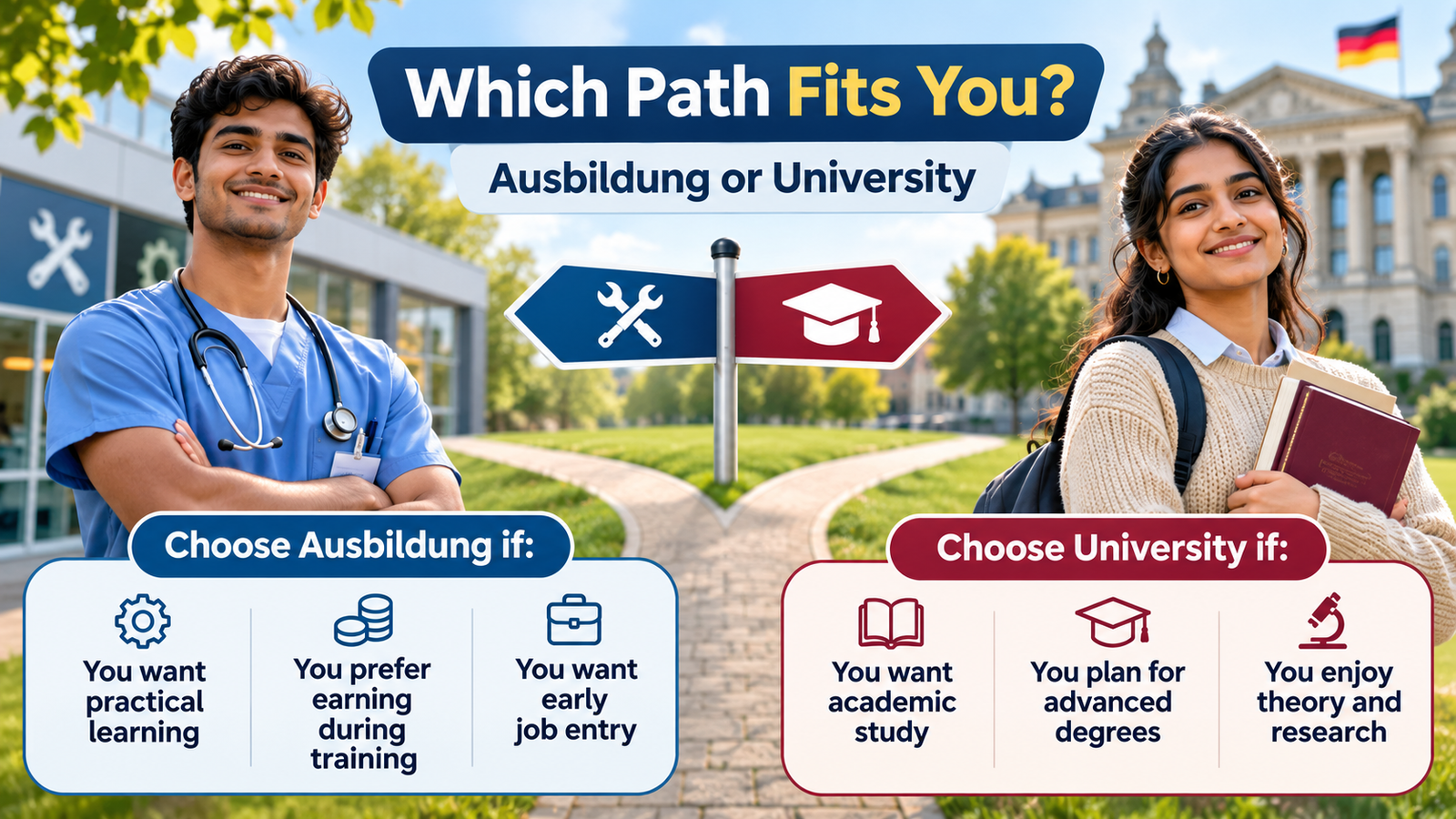
| Learning a trade through hands-on work | Ausbildung | Structured practical training in a specific occupation |
| Receiving regular income during training | Dual Ausbildung | Normally includes a monthly allowance |
| Studying medicine, research or advanced academic subjects | University | Degree and profession-specific academic training |
| Going on to master’s or doctoral research | University | Established academic progression routes |
| Combining a degree and employer experience | Dual study | Academic learning plus workplace integration |
| Working in hospitality or technical trades | Relevant Ausbildung | Direct occupational training where suitable |
Realistic Examples for Indian Applicants
The student who enjoys repairing machines
Someone with a strong interest in mechanics may enjoy mechatronics Ausbildung. The student should still check German, technical course requirements and the actual contract before applying.
The student who wants to become a research scientist
A university degree, laboratories and advanced academic study may provide the more appropriate foundation. An unrelated Ausbildung would not automatically substitute for the needed degree.
The student who wants to work in software
IT Ausbildung and university computer science can both be relevant. The decision depends on whether the student prefers workplace-led learning or a deeper academic curriculum, and the roles they want after graduation.
Common Mistakes to Avoid
- Choosing only by advertised salary: Training allowance is not the same as qualified employment pay.
- Assuming German university is always free: Some degrees and institutions charge tuition.
- Ignoring German language: Practical communication helps in both routes.
- Confusing a training offer with a visa: Immigration permission remains a separate decision.
- Believing either option guarantees a job: Employment depends on skills and actual opportunities.
- Forgetting rent and insurance: Living costs matter even if tuition is low.
Frequently Asked Questions
Is Ausbildung better than university for Indian students?
Neither is universally better. Ausbildung can suit practical vocational goals; university suits academic, research and degree-specific careers.
Can I apply for Ausbildung after Class 12?
Some employers and programmes accept suitable school-leaving qualifications. Language and programme-specific conditions still apply.
Does Ausbildung pay students every month?
Dual vocational programmes normally include a monthly allowance. School-based vocational programmes may use different arrangements.
Are universities in Germany free for international students?
Many public degrees have no general tuition, but semester contributions and living costs apply, and some universities or programmes charge tuition.
Which route is faster?
Many Ausbildung programmes last 2–3.5 years. Many bachelor’s degrees last 3–4 years, with additional time for postgraduate study. Duration depends on the specific qualification.
Is B1 German enough for Ausbildung?
B1 is normally relevant for the vocational-training visa, but an employer or profession may expect more.
Can I work after graduating from university or finishing Ausbildung?
Potentially, subject to obtaining the appropriate residence title for your employment or job search.
Which offers better permanent-residence options?
Both may lead toward longer-term residence if further legal requirements are met. Neither automatically guarantees permanent residence.
Final Verdict: Choose Your Career Before Choosing Your Course
For Indian students, the strongest option is the one that clearly matches their goals. Ausbildung can provide a practical beginning in a recognised occupation with a training allowance. University can provide academic depth and access to professions requiring a degree. The best decision comes from looking at the real course, future work, language, finances and eligibility.
Explore our top Ausbildung courses and salary tables, or contact Europe Careers to discuss study and training pathways for your background.