
What Is Ausbildung in Germany? Complete Guide for Indian Students

A practical guide for Indian students • Updated November 2026 • Europe Careers
Not everyone who wants to build a future in Germany wants to spend several years at a university. Maybe you enjoy practical work, like learning new skills by actually doing them, or want a qualification that connects directly to a profession. That’s where Ausbildung in Germany often comes into the conversation.
But a few questions quickly follow: Is Ausbildung a job or a course? Do students get paid? Can someone apply from India after Class 12? Is German compulsory? What are the visa requirements? And what happens when training ends?
This complete guide explains the process in straightforward language, without promising guaranteed jobs or treating every training programme as identical. If you are exploring vocational education in Germany for 2027 or later, it will help you understand what to investigate before applying.
Ausbildung at a glance: A structured German vocational training pathway, often combining company-based practice and vocational school. Many dual programmes pay a training allowance and last about two to three and a half years. Eligibility, German language, fees and immigration conditions depend on the exact route.
What does Ausbildung actually mean?
Ausbildung is the German word for vocational training. In everyday conversations about careers, it usually refers to a structured programme that prepares someone for a recognised occupation. Rather than learning everything from textbooks and only then looking for work, many trainees spend part of their time with an employer and part at a vocational school.
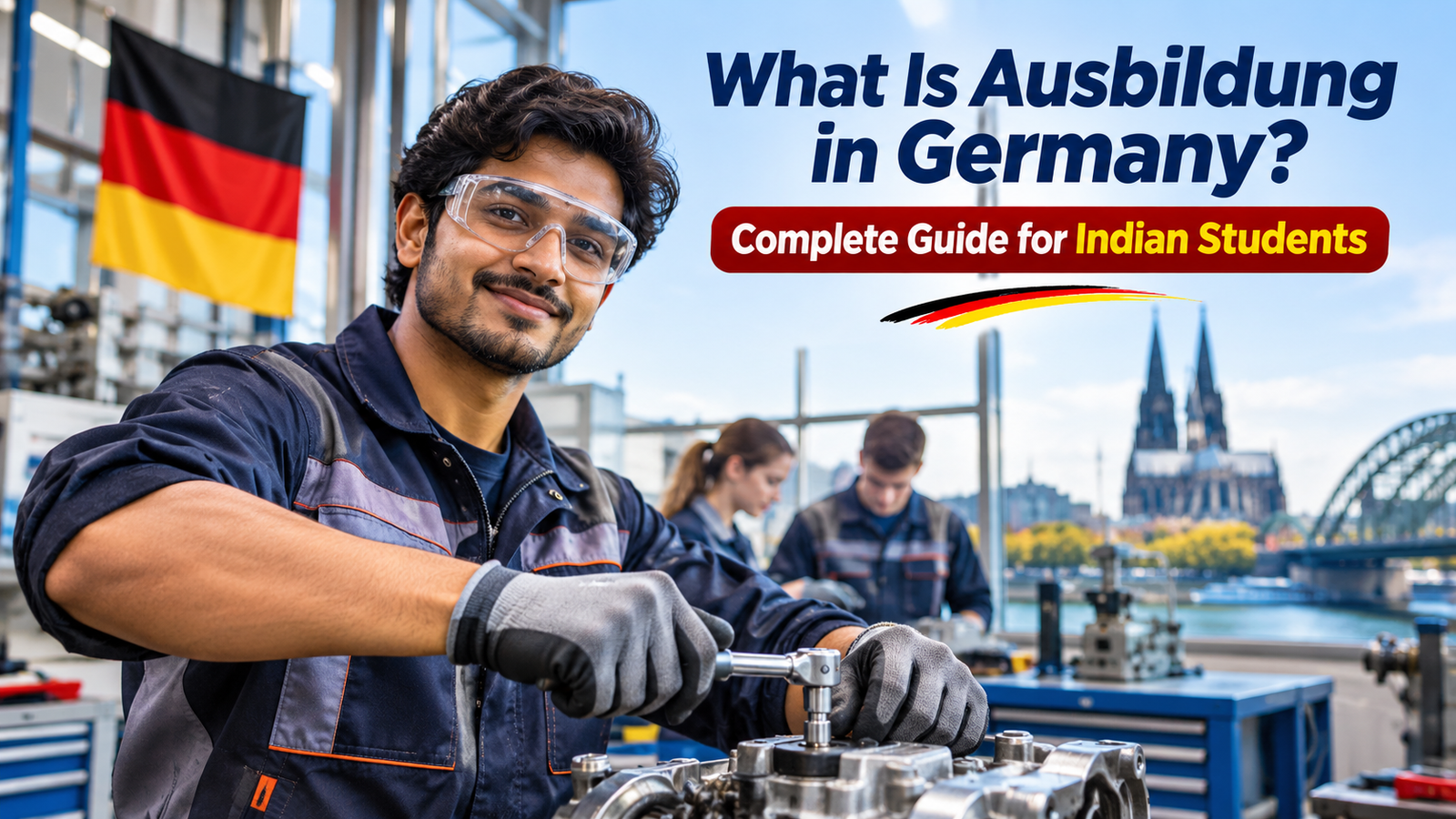
Think of a student learning mechatronics. At the company, they might learn to inspect components, use tools, follow safety procedures and understand how real machines work. At vocational school, they study the principles behind those tasks. Over time, the workplace and classroom reinforce each other. That is the basic idea of Germany’s dual vocational training system.
It is important not to confuse Ausbildung with a university degree, a short private course or an ordinary entry-level job. It is an organised route toward professional skills and, when successfully completed, a recognised vocational qualification. For Indian students who prefer learning by doing, this can be an interesting alternative to a purely academic route.
How dual vocational training works in Germany
In dual Ausbildung, the employer is an active part of your education. You normally sign a training contract, work under supervision and receive practical instruction at the company. You also attend a Berufsschule, or vocational school, to learn theory, general subjects and occupational knowledge. Depending on the occupation, lessons may take place on certain days of the week or in blocks.
The experience is not identical across every occupation. A trainee in hotel operations may spend time with guests, reservations and service teams. A trainee in electronics might learn about circuits, diagnostics and industrial equipment. A trainee in retail may practise customer communication, stock control and basic commercial processes.
What stays consistent is the expectation that you are there to learn a profession, not just fill a shift. There is an agreed training plan, progress is assessed, and the programme usually ends with an examination organised under the relevant rules.
Dual Ausbildung vs school-based Ausbildung
Not every Ausbildung works in exactly the same way. Dual vocational training normally combines an employer, a vocational school and a monthly training allowance paid by the company. This model is common across many commercial, technical and craft occupations.
School-based vocational training is organised primarily through an education provider and may include practical placements. Some school-based courses charge fees or do not provide a regular allowance, while others—including certain healthcare pathways—have different funding arrangements. It is therefore inaccurate to say that every Ausbildung is free and pays exactly the same monthly salary.
When comparing programmes, ask three questions: Who provides the training? Will you receive a written training contract and allowance? And which qualification will you receive upon completion? These answers affect both your financial plan and your visa documentation.
How long does Ausbildung take?
Most recognised vocational training programmes take approximately two to three and a half years, depending on the occupation and training rules. Some students may be eligible for a shortened training period under particular circumstances, but that is not guaranteed and should be confirmed with the training provider and responsible body.
Many programmes begin in late summer or autumn, although start dates can differ between professions and employers. A student who wants to begin in 2027 should ideally start researching occupations, learning German and preparing applications well in advance. Waiting until the month before the start date may mean missing good opportunities or not having enough time to arrange visa documentation.
The length of a programme can also affect the way you budget. A two-year course and a three-and-a-half-year course involve different periods of accommodation, living costs and training income. Do not decide based on duration alone: the real question is whether you want to work in that field afterward.
Who can apply for Ausbildung from India?
Indian citizens can apply for suitable vocational training places in Germany when they meet the requirements of the employer, training programme and applicable immigration route. There is no universal rule stating that every Ausbildung has the same minimum age, academic score or school qualification. Employers may prefer applicants with particular subjects, education levels or experience.
Completing Class 12 can be useful for many applicants, but it does not automatically guarantee admission to every training programme. Some school-based pathways have specific school-certificate recognition requirements. Certain occupations involve additional health, professional or suitability conditions.
It is also worth separating the visa for an existing training place from the visa to search for a training place. The second route has particular eligibility conditions, including an age limit under 35 under the rules currently published, along with German-language, educational and financial requirements. That does not mean everyone aged 35 or above is universally banned from undertaking Ausbildung with a qualifying training offer.

Is German language compulsory for Ausbildung?
For most applicants, German language ability is one of the most important parts of preparation. Lessons, practical instructions and final examinations are commonly conducted in German. For the vocational-training visa, B1 German is normally expected, subject to the rules and possible alternatives that apply to particular cases.
Some employers or occupations may expect B2 or another level because of the communication involved. Nursing, care-related work and customer-facing jobs can be especially demanding. A certificate is valuable, but the ability to actually understand instructions and speak confidently is equally important.
Imagine the first week in a workshop or hospital. People may speak faster than your language textbook, and you might need to ask questions about a safety instruction or an unfamiliar task. Building genuine listening and speaking skills makes those moments less stressful.
If you are beginning from A1, create a realistic learning plan and take the time to practise daily. Europe Careers provides information about German language courses A1–B2 for learners preparing for Germany.
Popular Ausbildung fields Indian students explore
There are many recognised vocational occupations in Germany. The right one depends on your interests, school background, strengths and willingness to perform the actual work—not simply the title or advertised allowance.
- Nursing and care: Working with patients, care teams and healthcare routines, subject to the specific training and professional requirements.
- Mechatronics: Combining mechanical systems, electronics and technical problem-solving.
- Electronics: Learning installation, diagnostics, maintenance and safety in relevant technical settings.
- IT specialist training: Developing practical skills in software, networks, systems and support roles.
- Hotel and hospitality: Learning guest service, operations and daily hotel or restaurant processes.
- Logistics: Working with goods, inventory, warehousing and supply-chain processes.
- Retail and commercial occupations: Understanding customer service, products, sales and business operations.
These are categories of training, not promises that every position is available to international applicants at every moment. Read the training occupation carefully, ask what a normal working day looks like and understand how much communication the employer expects in German.
How much does Ausbildung pay in Germany?
One of the reasons dual Ausbildung receives attention is that trainees normally receive a monthly training allowance (Ausbildungsvergütung). The amount varies according to occupation, employer, collective agreement, location and training year. It often increases as the trainee progresses, but the actual schedule depends on the contract.
This allowance is not the same as the salary of a qualified worker after graduation. It is intended to support someone who is still learning, and it may not cover every expense in an expensive city. Some school-based programmes may not pay an allowance at all.
A useful distinction is between the minimum income required for visa financial evidence and the actual allowance offered by the employer. For 2026, Germany’s published visa guidance treats an in-company training allowance of at least €1,048 gross or €822 net per month as generally sufficient evidence of living expenses under that route. If the allowance is below the required level, the applicant may need to prove additional funds through an accepted method. These are financial-proof benchmarks, not a claim that every trainee earns exactly that amount, and 2027 thresholds need to be checked when applying.
Ausbildung salary vs the real cost of living
Before accepting a training offer, work out a budget for the city where you will actually live. Rent, deposits, utilities, food, insurance, transport and mobile bills can add up quickly. The same allowance may feel very different in a smaller town compared with an expensive urban centre.
Ask whether your employer provides housing assistance, meals, a transport benefit or other practical support. If accommodation is offered, get the price and conditions in writing. You should also budget for the first month, when costs may arise before your normal payment routine begins.
Some trainees can work a separate part-time job for up to 20 hours per week under the applicable vocational-training residence rules. However, an additional job is not guaranteed, and your primary training obligations still matter. Plan your finances conservatively rather than relying on the hope of immediate extra income.
Is Ausbildung free for Indian students?
In many dual vocational programmes, trainees do not pay traditional university-style tuition and instead receive an allowance from the employer. But the word “free” can be misleading. You still need to account for German classes, examinations where relevant, applications, document preparation, visa charges, travel, accommodation and everyday living costs.
School-based vocational programmes can follow different fee and funding arrangements. Some may require proof of living expenses without an employer-funded allowance. Even when the training itself involves no tuition, relocating to Germany is not cost-free.
Ask any adviser or training provider to explain every charge clearly. Separate official fees, third-party service charges and optional support packages. No genuine professional should imply that a private payment guarantees an Ausbildungsplatz, the German term for a training place, or a visa.
Ausbildung visa requirements for Indian students
Indian nationals normally need the appropriate visa or residence authorisation to complete vocational training in Germany. For a standard training-place application, the key elements typically include a confirmed training place, sufficient language ability and evidence that living expenses can be covered.
The accepted financial evidence varies by training format. Under the published 2026 guidelines, school-based training generally requires at least €959 net per month in available support, while company-based training may use the qualifying training allowance and, if necessary, supplementary funds. These figures are not promises about 2027 and should be rechecked before submitting an application.
German authorities may also seek approval from the Federal Employment Agency for company-based vocational training. Where relevant, that is handled as part of the official procedure. Meeting the basic checklist does not guarantee approval; the competent authorities must assess the complete application.

Documents you may need for your Ausbildung application
Document requirements are not identical for every training programme or visa case, but it helps to prepare the basics early. Common items include a valid passport, school certificates, academic transcripts, CV, motivation letter, German language evidence, a signed training contract, any required training plan, and financial or insurance documents appropriate to your route.
If a school certificate requires recognition or additional verification, follow the instructions issued for that programme or visa category. Where translations are required, check which languages and certification standards are accepted. Keep all dates and names consistent across forms and supporting records.
Your CV should show your education honestly and explain any relevant practical experience, internships or projects. A strong motivation letter should connect your actual interests to the chosen occupation. A student who has spent time repairing machines can explain why technical training appeals to them; someone interested in hospitality can talk about their communication experience and genuine interest in service work.
Never submit a fabricated language certificate or a job contract that you cannot verify. Incomplete or false documentation can cause serious problems.
How to find an Ausbildung in Germany from India
Start by choosing an occupation, not by searching for “any Ausbildung with the highest salary.” Look at the work involved, the qualification earned, its typical duration and the level of German required. Once you understand the role, search for genuine vacancies through employer career pages, established employment platforms and vocational training opportunities.
Use German job titles alongside English descriptions. For example, a candidate interested in mechatronics can search for Ausbildung Mechatroniker, while someone interested in commercial work should learn the relevant German occupation name rather than sending the same CV to unrelated jobs.
Apply directly where possible and check that the employer has a real website, a credible contact and a clearly described training role. Keep a tracker of applications, interview invitations and required documents. If an advertisement promises a guaranteed place without looking at qualifications or language, be cautious.
How the application and interview process works
The exact application process depends on the employer. You may submit a CV, cover letter, school records and language evidence. Some employers invite candidates to an online interview, aptitude test or practical assessment. Others request additional information before deciding whether to offer a training place.
During an interview, the recruiter may ask why you chose that profession, what you know about the company and how prepared you are to learn in German. It helps to be specific. Instead of saying that you want to move to Europe because everyone does, explain what interests you about the trade and what you would like to learn.
If selected, read the training contract carefully. Confirm the occupation, dates, training location, allowance, weekly hours, probation conditions and any assistance provided with accommodation. A written offer is an important step, but it does not replace the official visa process.
The journey from India to Germany
A successful application involves several connected stages rather than one form. First, identify a vocational field that suits your interests and qualifications. Then develop the language level needed to study and work in that environment. Collect your school and identity documents, research legitimate employers, apply to programmes and prepare for interviews.
Once you receive a suitable contract, check the vocational-training visa category, arrange financial evidence and submit your application through the applicable German mission or official online procedure. Respond to requests for further documentation promptly and do not make irreversible travel arrangements before approval.
After arrival, you may need to register your address, understand your insurance arrangements and complete residence formalities. Your employer or school may help with onboarding, but the amount of assistance varies.
This sequence is not a guaranteed timeline. Some students find an employer quickly; others need more time to improve German, obtain school documentation or complete the selection process.
What life as an Ausbildung trainee is really like
The first few weeks can feel exciting and exhausting at the same time. You are learning a new profession, adjusting to a different workplace and processing German conversations throughout the day. You may also be managing a budget, cooking for yourself, finding your way around public transport and making new friends.
Training can involve early shifts, practical assessments and school assignments. In some industries, there may be physical demands or weekend work under the relevant rules. Success requires more than enthusiasm for moving abroad; it requires consistent effort and a willingness to ask questions when something is unclear.
One useful habit is to keep a notebook of new German vocabulary you hear at work. Learn the names of tools, equipment, procedures and everyday instructions. Over time, this makes the workplace less intimidating and improves your confidence in both classes and practical training.

What happens after completing Ausbildung?
After passing the required examinations, you receive the vocational qualification associated with your training. This can open the door to employment as a qualified worker, depending on vacancies, recognition of your completed training and the residence rules that apply to you.
Germany’s published rules allow eligible graduates of vocational training to seek a residence permit for up to 18 months to look for qualified employment. This is a possible legal pathway, not an automatic guarantee that every graduate will receive a job or permanent residence.
Some trainees are offered work by their training company. Others apply to different employers or decide to continue professional development. Your language skills, work record, occupation and professional relationships can all influence your opportunities.
Think of Ausbildung as the beginning of a professional journey rather than a final destination. Continuing education and specialisation may become relevant later in your career.
Ausbildung compared with studying at university
A traditional university programme generally emphasises academic study and may lead toward specialist, scientific or professional graduate careers. Dual Ausbildung combines job-related classroom learning with structured practical training and typically an allowance. The better path depends on the work you want to do and the way you prefer to learn.
For someone who enjoys technology but prefers hands-on problem-solving to an academic engineering course, an appropriate technical Ausbildung may be worth researching. A student seeking a research-based or degree-specific profession may find university a more suitable route.
Neither pathway should be marketed as automatically superior. Qualification recognition, career development and future job roles can differ considerably. Before applying, ask what qualification you will actually receive and how it relates to the career you want.
Common mistakes Indian applicants should avoid
Choosing only by stipend: A high advertised allowance does not mean you will enjoy the occupation or save more money. Ignoring German: Training school and workplace communication can be challenging without strong language skills. Assuming all programmes are free: Fees and training arrangements differ.
Confusing visa categories: An applicant with an existing training contract does not necessarily follow the same route as someone searching for a training place. Relying on social media promises: Neither an employer nor an agent can guarantee a visa decision.
Skipping contract details: Read allowances, working conditions and training responsibilities before signing. Underestimating the first-year budget: Initial housing deposits, travel and daily costs can be significant.
A serious opportunity should remain credible even after you ask detailed questions. Never feel pressured to pay immediately because someone says the offer will disappear unless you transfer money.
Frequently asked questions about Ausbildung in Germany
Can Indian students apply for Ausbildung after Class 12?
Yes, some pathways may be suitable, subject to the employer’s and programme’s specific education, language and visa requirements. Class 12 alone does not guarantee admission.
Is Ausbildung the same as an internship?
No. Ausbildung is a structured vocational education route intended to lead to a recognised professional qualification, not simply short-term work experience.
How many years does Ausbildung take?
Many programmes last roughly two to three and a half years, depending on the occupation.
Do trainees receive a monthly salary?
Dual vocational training usually provides an employer-paid allowance. School-based arrangements can differ. The actual amount is determined by the programme and contract.
Is B1 German enough?
B1 is normally the baseline for the vocational-training visa, subject to applicable conditions. Some programmes and occupations expect stronger practical language skills or a higher level.
Is there an age limit?
There is no single age limit applying to all Ausbildung programmes. The separate visa to seek a training place has an under-35 requirement under the currently published rules.
Can I apply without an agent?
Yes. You can research and apply directly to suitable employers and follow the official visa procedure. An agent is not required for every application.
Can I study nursing through Ausbildung?
There are recognised nursing training pathways, but their education, language, remuneration and professional conditions need to be checked individually.
Is accommodation provided?
Some employers may assist, but accommodation is not a universal benefit of Ausbildung. Get any support confirmed in writing.
Can I work part-time during training?
Under relevant vocational-training residence rules, a separate job of up to 20 hours weekly may be permitted. Your actual circumstances and training commitments matter.
Does completing Ausbildung guarantee permanent residence?
No. Completing a programme can create opportunities to pursue employment and an appropriate residence title, but further requirements apply.
Will the 2026 visa financial thresholds apply in 2027?
Not necessarily. Check the applicable amounts and rules at the time of application.
Your next step toward Ausbildung
The most useful thing you can do today is choose one or two professions that genuinely interest you and investigate what daily work in those fields looks like. Then find out the language level, school qualifications, application dates and financial preparation needed. You do not have to know every detail immediately, but you should understand enough to make an informed choice.
At Europe Careers, we help interested candidates explore German language preparation, vocational career pathways and the practical stages of applying from India. You can learn more on our Ausbildung in Germany for Indian Students page, explore specific programmes such as Mechatronics Ausbildung or Nursing Ausbildung, and contact our team for guidance.
Your admission, training contract and visa decisions depend on the respective training organisations and German authorities. A realistic plan starts with your own skills and goals.



[…] the complete Ausbildung guide and explore German language […]