
Nursing Ausbildung in Germany 2027 — Complete Guide for Indian Students

Updated November 2026 | Complete nursing Ausbildung preparation guide for Indian students planning a 2027 intake.
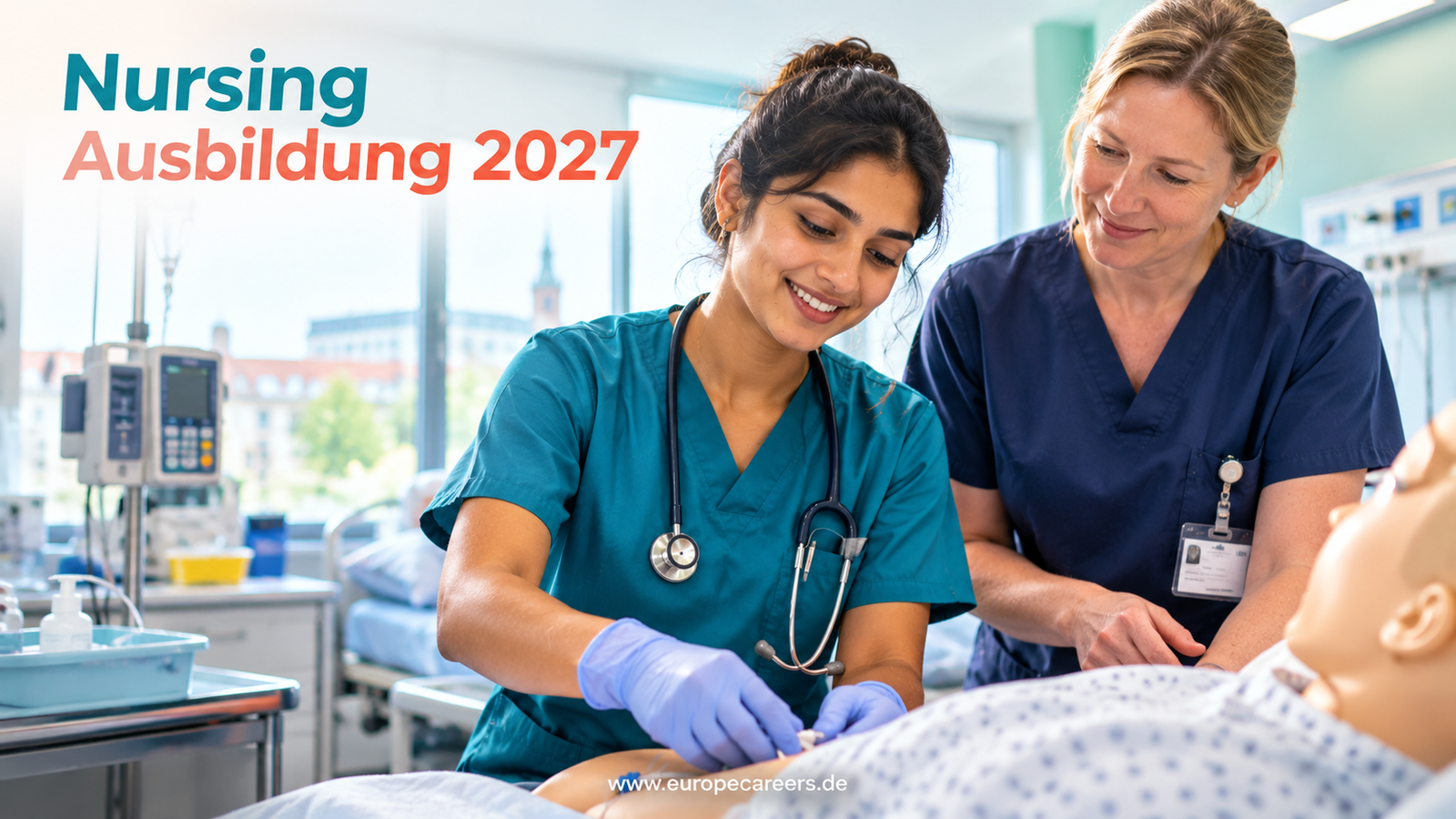
Nursing Ausbildung in Germany 2027 can be a practical route for Indian students who want to become qualified nurses through structured vocational training rather than starting with a university nursing degree. The programme combines classroom learning with supervised clinical experience, generally lasts three years full-time and provides a monthly training allowance.
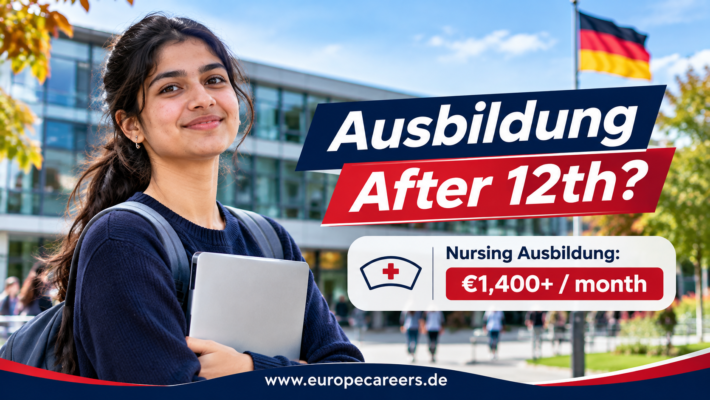
For a real 2027 nursing vacancy published on the German Federal Employment Agency’s jobs portal, the advertised gross stipend is €1,490.69 per month in year one, €1,552.07 in year two and €1,653.38 in year three. These are verified figures from particular employers, not a universal salary guarantee for every trainee.
Indian applicants normally need an appropriate school qualification, German-language competence, evidence of suitability for nursing, a genuine training place and the correct vocational training visa. German requirements vary by federal state and provider: B1 or B2 may apply. Europe Careers recommends preparing to B2 German to handle nursing-school lessons, patient communication and interviews more confidently.
This guide explains eligibility after Class 12, the training curriculum, salary versus take-home pay, documents, applications, visas, accommodation, workplace expectations and career opportunities after qualification. The 2027 rules and employer offers should be checked again before submitting an application.
What is Nursing Ausbildung in Germany?
Nursing Ausbildung is Germany’s regulated vocational training pathway to becoming a nursing professional, commonly called Pflegefachfrau, Pflegefachmann or Pflegefachperson. It is not simply a short nursing assistant course or a private certificate. Successful completion of the required training and state examination leads toward the recognised professional qualification.
The programme combines nursing-school instruction with supervised practical training in hospitals, long-term care facilities, outpatient nursing services and other healthcare settings. Trainees learn to assess patient needs, provide safe care, communicate with patients and colleagues, and document their work accurately.
Germany’s generalist nursing training covers people across different age groups and care environments. It provides a broad foundation before graduates develop more specialised skills through professional experience or further education.
The training is suitable for applicants who genuinely want to care for patients and can manage physical work, emotional situations and shift-based healthcare routines. It should not be chosen solely because a training salary is advertised.
Nursing Ausbildung 2027: Key facts at a glance
These are the main features to understand before applying. Individual institutions may have additional conditions.
| Topic | What Indian students should know |
|---|---|
| Qualification | State-regulated generalist nursing qualification |
| Standard duration | 3 years full-time; part-time can take up to 5 years |
| Learning format | Nursing school plus supervised practical rotations |
| School eligibility | Intermediate school qualification or accepted equivalent |
| German language | B1 or B2 depending on state/provider; B2 recommended |
| Training allowance | Paid, but employer and year determine amount |
| 2027 verified example | €1,490.69 gross per month in first year |
| Visa | Usually vocational training visa/residence permit under Section 16a |
| Final assessment | State examination |
| Career direction | Hospitals, long-term care, outpatient nursing and specialisations |
Unlike an ordinary classroom-only course, nursing Ausbildung involves real clinical responsibilities under supervision. Candidates should understand both the educational and workplace aspects before signing a contract.
Can Indian students apply after Class 12?
Yes. Many Indian students can apply for nursing Ausbildung after completing Class 12, provided their school qualification is accepted and they satisfy the training provider’s requirements. A Bachelor’s degree in nursing is not normally necessary to begin this vocational pathway.
Germany generally requires an intermediate school-leaving qualification or an accepted equivalent. Some applicants with other school backgrounds may qualify through an additional completed vocational qualification, depending on the applicable rules.
For Indian students, school certificate evaluation can be important. An employer or nursing school may request equivalence evidence, certified copies or translated records. Requirements can vary between federal states and institutions.
Applicants from science, commerce or arts backgrounds should not assume that every training provider has identical subject preferences. Review the actual vacancy and school rules. Strong communication, willingness to learn and a genuine interest in patient care matter alongside formal eligibility.
Eligibility requirements for Indian applicants
Before applying, assess the complete profile rather than focusing only on marks or German-language certificates. Healthcare employers need trainees who can work safely and reliably with vulnerable patients.
| Requirement | Typical expectation | What to verify |
|---|---|---|
| Education | Accepted intermediate school qualification | School equivalence and provider criteria |
| German language | B1 or B2 depending on federal state | Certificate type and required level |
| Health | Physical and mental fitness for nursing | Accepted medical certificate |
| Reliability | Evidence of good conduct | Police clearance or equivalent |
| Training place | Genuine contract and nursing-school arrangement | Employer identity and training location |
| Financial means | Adequate living resources | Applicable 2027 visa threshold |
| Passport and visa | Valid documents and Section 16a route | Current German mission checklist |
There is no single nationwide rule that every nursing Ausbildung applicant must be exactly a particular age. However, different visa categories have different age rules. For example, the separate visa to search for a vocational training place has an under-35 requirement under current law; that should not be confused with applying with an already secured training contract.
German B1 versus B2 for Nursing Ausbildung
German is essential because nursing involves patient safety, medication-related communication, written records, handovers and understanding instructions. The official German government guidance says nursing trainees need B1 or B2 depending on the federal state.
The general vocational training visa normally refers to B1 if the training institution has not already assessed the applicant’s language skills or arranged appropriate preparation. But the nursing school’s own rules may be stricter, and some providers expect B2 before starting.
Europe Careers recommends reaching B2 before departure wherever possible. This is a career-readiness recommendation, not a claim that B2 is a universal statutory visa minimum. Stronger German can help students understand clinical lessons, speak with elderly patients and handle unexpected situations.
Learn workplace vocabulary as well as examination grammar. Practise explaining symptoms, asking permission before care, describing pain, documenting observations and reporting urgent changes to a supervising nurse.
See German language requirements for Ausbildung in 2027 for more detail.
How the three-year nursing training programme works
The programme combines theoretical instruction and practical rotations over three years. A published 2027 nursing vacancy describes at least 2,100 hours of theoretical and practical instruction and 2,500 hours of practical training, reflecting the statutory training structure.
Students learn about anatomy, nursing processes, hygiene, patient mobility, nutrition, medication safety, communication, ethics and documentation. Practical placements develop these skills in supervised clinical settings.
The first two years establish a broad generalist foundation. Before the third year, trainees may have specific options regarding a generalist qualification or certain specialisation pathways, subject to the programme’s legal structure and arrangements.
Assessment is continuous, and the programme concludes with a state examination. Passing requires more than attendance; students must demonstrate theoretical understanding and safe practical competence.
What will you learn in the first, second and third years?
Training content is organised around competency development rather than a simple identical national timetable. The following is an illustrative overview, not a promise that every nursing school teaches topics in this order.
| Training stage | Typical learning focus | Practical development |
|---|---|---|
| First year | Basic care, hygiene, anatomy, communication | Supervised observations and daily care |
| Second year | Complex care needs, documentation, clinical reasoning | Rotations across different settings |
| Third year | Independent planning within trainee scope, exam preparation | Greater responsibility under supervision |
As trainees progress, they are expected to communicate more precisely, understand risks and contribute to the nursing process. The supervising staff remain responsible for appropriate delegation and patient safety.
Where do nursing trainees complete practical placements?
Practical rotations can include hospitals, nursing homes, outpatient care services, paediatric settings, psychiatric care and other approved institutions. The exact sequence depends on the training provider and local arrangements.
Hospital placements expose students to acute care, monitoring and multidisciplinary teamwork. Long-term care placements focus on ongoing support, mobility, chronic conditions and relationships with residents. Outpatient services introduce home-based care and different organisational challenges.
Students should expect unfamiliar routines and new teams. Ask the employer how placements are arranged, whether travel between sites is required and who provides practical supervision.
Clinical training is not a licence to perform tasks independently beyond your competence. Follow instructions, ask questions and report concerns promptly.
Nursing Ausbildung salary in 2027: Real employer figures
Salary is a major consideration for Indian applicants, but every advertised amount needs context. A verified 2027 nursing training vacancy on the Federal Employment Agency portal lists the following gross monthly allowances:
| Training year | Monthly gross stipend | 12-month gross equivalent |
|---|---|---|
| Year 1 | €1,490.69 | €17,888.28 |
| Year 2 | €1,552.07 | €18,624.84 |
| Year 3 | €1,653.38 | €19,840.56 |
These amounts are specific to the published employer’s remuneration terms and reference date. They should not be presented as the minimum salary for every nursing trainee in Germany. Other hospitals, private care providers and regional employers may offer different allowances or benefits.
The same 2027 vacancy describes possible additional benefits. Whether a particular Indian applicant qualifies for an offer, allowance or benefit depends on the employer and contract.
Always request the written year-by-year salary schedule. Check the contract’s start date, collective agreement, possible shift supplements and whether accommodation is provided.
Gross stipend versus net take-home salary
The training allowance in a job advertisement is generally gross pay, not the exact amount transferred to the trainee’s bank account. Social insurance contributions normally apply, including health, pension, unemployment and care insurance.
Actual net pay depends on individual circumstances and current payroll rules. A simple fixed deduction percentage is not reliable for everyone, so use an up-to-date German payroll calculator or ask the employer for an indicative payslip.
Budget for rent, groceries, transport, phone, insurance and initial setup costs. A stipend above €1,400 gross can be attractive, but the amount left after essential expenses varies by city and housing arrangement.
Some employers offer accommodation assistance, subsidised transport or other support. Ask for written details rather than assuming these benefits are standard across all hospitals.
Can nursing trainees earn extra money during training?
Nursing training can include early, late and weekend shifts, and some settings require night-duty experience under applicable training rules. The treatment of supplements depends on the employer’s collective agreement and contract.
Under the vocational training residence framework, an additional job independent of training may be permitted for up to 20 hours weekly, subject to the applicable residence and employment conditions. However, nursing Ausbildung is demanding, and an extra job may affect study time and recovery.
Before taking additional work, check your training contract, legal working-time limits and the residence title. Never assume that all extra shifts are optional or that every trainee receives identical bonuses.
Nursing Ausbildung visa for Indian students
Indian nationals generally need a national visa for vocational training before travelling to Germany. The relevant residence title for nursing Ausbildung is normally under Section 16a of the German Residence Act.
A confirmed training place, appropriate German-language evidence, valid passport, adequate living resources and required insurance are central parts of the application. The Federal Employment Agency may review employment conditions as part of the procedure.
Official 2026 guidance states that a company-based training allowance of at least €1,048 gross or €822 net per month can generally demonstrate sufficient living resources. These are 2026 benchmarks, not guaranteed 2027 amounts. If the salary is below the applicable threshold, additional proof may be necessary.
Use the latest instructions from the German mission and the Consular Services Portal. Do not transfer money to an agent based solely on an informal promise that a visa will be issued.
Nursing Ausbildung documents checklist
Prepare your documents early because school verification, translations and appointment procedures can take time. Exact requirements vary by employer, school and German mission.
| Document | Why it is needed |
|---|---|
| Valid passport | Identity and visa application |
| Class 10 and 12 certificates | Educational eligibility |
| School equivalence evidence, if required | Recognition of prior schooling |
| German language certificate | Communication and admission evidence |
| German-style CV | Employer screening |
| Motivation letter | Interest and suitability for nursing |
| Training contract | Confirmed training placement |
| Nursing-school confirmation | Academic training arrangement |
| Medical fitness certificate | Suitability for healthcare work |
| Police clearance/good conduct | Reliability requirement |
| Financial and insurance evidence | Visa and living-cost requirements |
Some documents may be requested only later in the process. Follow the current checklist and never submit false experience letters, altered marksheets or unofficial language certificates.
Step-by-step application process from India
Choose the nursing pathway. Understand the difference between three-year nursing professional training and shorter nursing assistant programmes. Decide whether the professional qualification fits your goals.
Start German preparation. Build a solid language foundation and work toward B2. Practise spoken German, listening comprehension and common nursing situations.
Check school eligibility. Confirm that your Indian school certificates satisfy the training provider’s requirements and whether an equivalence assessment is necessary.
Prepare a German application. Create a clear CV, motivation letter and supporting documents. Explain why you want to become a nurse rather than focusing only on salary or migration.
Find legitimate training vacancies. Apply through hospital, care provider and Federal Employment Agency job portals. Verify employer details and training-school arrangements.
Attend the interview. Be ready to discuss patient care, teamwork, shift work, personal motivation and your ability to learn in German.
Review and sign the contract. Check training dates, stipend, location, probation, rotations, leave and any accommodation support.
Apply for the visa. Submit the required evidence through the official procedure and make travel arrangements only after receiving the appropriate approval.
Where can Indian students find genuine nursing training positions?
Start with the German Federal Employment Agency’s jobs portal, hospitals’ own careers pages and reputable care organisations. Search for terms such as Ausbildung Pflegefachfrau 2027, Ausbildung Pflegefachmann or Pflegefachperson Ausbildungsplatz.
Check the start date, language requirements, educational criteria and whether the employer can consider applicants who need a visa. Some advertisements are intended primarily for candidates already living in Germany; eligibility for international applicants must be confirmed.
Be careful with recruiters who promise guaranteed selection, ask for excessive payments or refuse to identify the employer. Germany also operates ethical recruitment programmes, including certain official nursing training partnerships involving India.
Europe Careers recommends verifying contracts and employers before sharing sensitive documents or making major payments.
Nursing Ausbildung interview questions and preparation
German nursing interviews often test motivation, communication and understanding of the profession. You may be asked why you chose nursing, how you would support an anxious patient, what you know about shift work or how you handle teamwork.
Prepare concise examples from school, volunteering or family responsibilities without inventing clinical experience. If you have never worked in a hospital, explain what you have learned about the profession and how you plan to develop.
Practice responding in German at a level appropriate to the vacancy. Interviewers may ask follow-up questions, so memorising a script without understanding the language is risky.
Read Ausbildung interview questions and preparation tips for more guidance.
What is everyday life like for nursing trainees in Germany?
Life as a nursing trainee involves balancing vocational-school lessons, practical rotations, homework and everyday responsibilities. Shift schedules may change, and some placements can require early starts or weekend attendance.
Students must learn professional boundaries, confidentiality and respectful communication with patients from different backgrounds. Documentation is an essential part of nursing, not optional paperwork.
Outside work, trainees manage housing, transport, shopping, banking and healthcare appointments. German language skills help with these tasks and reduce dependence on other people for basic communication.
Expect a period of adjustment. Build supportive relationships with classmates and colleagues, use available student services and ask supervisors for feedback.
Accommodation, living costs and monthly budgeting
Living costs depend heavily on location. A smaller town may offer lower rent than a major city, but housing availability and commuting options still need checking. Some healthcare employers offer accommodation assistance, while others do not.
Before accepting a contract, ask whether the employer has a staff residence, whether a deposit is required and how far the training school is from practical placements. Include travel between locations in your budget.
Remember that gross salary is not disposable income. Plan around your expected net pay and recurring bills, and keep savings for unexpected expenses or the first few weeks before payroll begins.
Nursing Ausbildung versus nursing assistant training
The three-year professional nursing qualification and shorter nursing assistant training are different pathways. Nursing assistant programmes are generally shorter, vary by federal state and may lead to different duties and employment options.
| Feature | Nursing professional Ausbildung | Nursing assistant training |
|---|---|---|
| Typical duration | 3 years full-time | Often 1–2 years, depending on state |
| Qualification | Regulated professional nursing qualification | State-specific assistant qualification |
| Training content | Broad nursing assessment and care planning | Support with basic care and delegated tasks |
| Salary during training | Generally paid | Payment varies; some programmes unpaid |
| Career scope | Professional nursing and further specialisation | Assistant roles and possible progression |
Do not accept a short assistant course believing it automatically awards the same qualification as a three-year nursing professional programme. Check the exact German occupational title on the contract.
Career opportunities after Nursing Ausbildung
After completing the state examination and meeting the applicable professional requirements, graduates can pursue nursing roles in hospitals, long-term care facilities, outpatient services and other healthcare settings.
Further training may open pathways into intensive care, operating theatre nursing, oncology, paediatrics, geriatric care, practical instruction or management. Entry into specialised roles depends on employer needs and additional qualifications.
Some graduates pursue university studies in nursing science, education or healthcare management. Others focus on building clinical experience first. A German qualification is valuable, but a job offer is never automatic.
Compare nursing employment opportunities in Germany if you are considering long-term career progression.
Salary after qualifying as a nurse
Qualified nurses generally earn more than trainees, but salaries depend on employer, collective agreement, federal state, experience, working hours and shift supplements. Do not compare a trainee’s monthly stipend directly with a qualified nurse’s full-time salary without checking the job level.
One published 2027 training vacancy mentions a full-time starting gross salary of approximately €3,510.30 per month after qualification under that employer’s stated conditions, before any applicable supplements. This is an employer example, not a national guarantee.
When comparing offers, consider net income, shifts, housing costs, annual bonuses and career-development opportunities. The best offer is not always the one with the highest headline salary.
Can you stay in Germany after completing training?
Successful graduates may be eligible to apply for a suitable employment residence permit when they obtain qualifying work. Germany also provides a job-search residence option for eligible graduates of vocational training, generally for up to 18 months under the applicable rules.
Permanent residence is a separate process. Official guidance describes a possible settlement route after completing German vocational training and working in Germany for two years, provided additional statutory conditions are met. This is not automatic and should not be marketed as guaranteed permanent residence.
Immigration rules can change, so confirm your residence options with the foreigners authority before your training residence permit expires.
Common mistakes Indian nursing applicants should avoid
One common mistake is assuming that B1 or B2 German alone guarantees a training place. Employers also assess educational qualifications, motivation, communication and professional suitability.
Another is believing that every nursing Ausbildung contract starts at the same salary. The verified €1,490.69 example is real, but it is not a statutory nationwide nursing stipend.
Applicants also confuse nursing professional Ausbildung with nursing assistant training or with recognition of an existing Indian nursing qualification. These routes have different purposes, durations and requirements.
Finally, avoid paying unverified recruiters for supposed guaranteed hospital contracts. Confirm the employer, training school, salary and visa pathway independently before committing funds.
How Europe Careers helps Indian students prepare
Choosing a nursing Ausbildung pathway requires realistic planning: educational eligibility, German-language preparation, verified training opportunities, interview readiness and an understanding of life in Germany.
Europe Careers helps Indian students understand Germany vocational pathways and prepare for employer expectations. We recommend B2 German preparation for nursing because confident communication is essential in clinical learning and patient care.
Explore Ausbildung opportunities for Indian students, German language preparation and contact Europe Careers for career guidance. Admission, employment and visa decisions remain with the relevant institutions and authorities.
Frequently asked questions about Nursing Ausbildung in Germany 2027
Final advice for Indian students planning 2027
Nursing Ausbildung can offer a recognised professional pathway in Germany for students who enjoy healthcare, practical learning and direct patient support. It is a demanding three-year programme, not an easy shortcut to migration.
Published 2027 employer offers demonstrate that first-year nursing training allowances can start above €1,400 gross monthly, but salary, accommodation and eligibility vary. Prepare German to B2 where possible, verify your school qualification, choose a genuine employer and understand the training contract before applying.
Official reference sources include Make it in Germany’s nursing Ausbildung guide, vocational training visa guidance and a published 2027 nursing vacancy with the salary example.
Information reflects November 2026 and is general educational guidance. Specific 2027 visa thresholds, training vacancies and employer terms should be reconfirmed before applying.


[…] our Nursing Ausbildung 2027 guide for the salary structure and professional […]