
How Can Indian Nurses Apply for Jobs in Germany When Their Nursing Qualifications Are Only Partially Recognised?
Updated November 2026 • A practical guide for Indian GNM, BSc Nursing and other eligible nursing graduates considering employment and professional recognition in Germany.
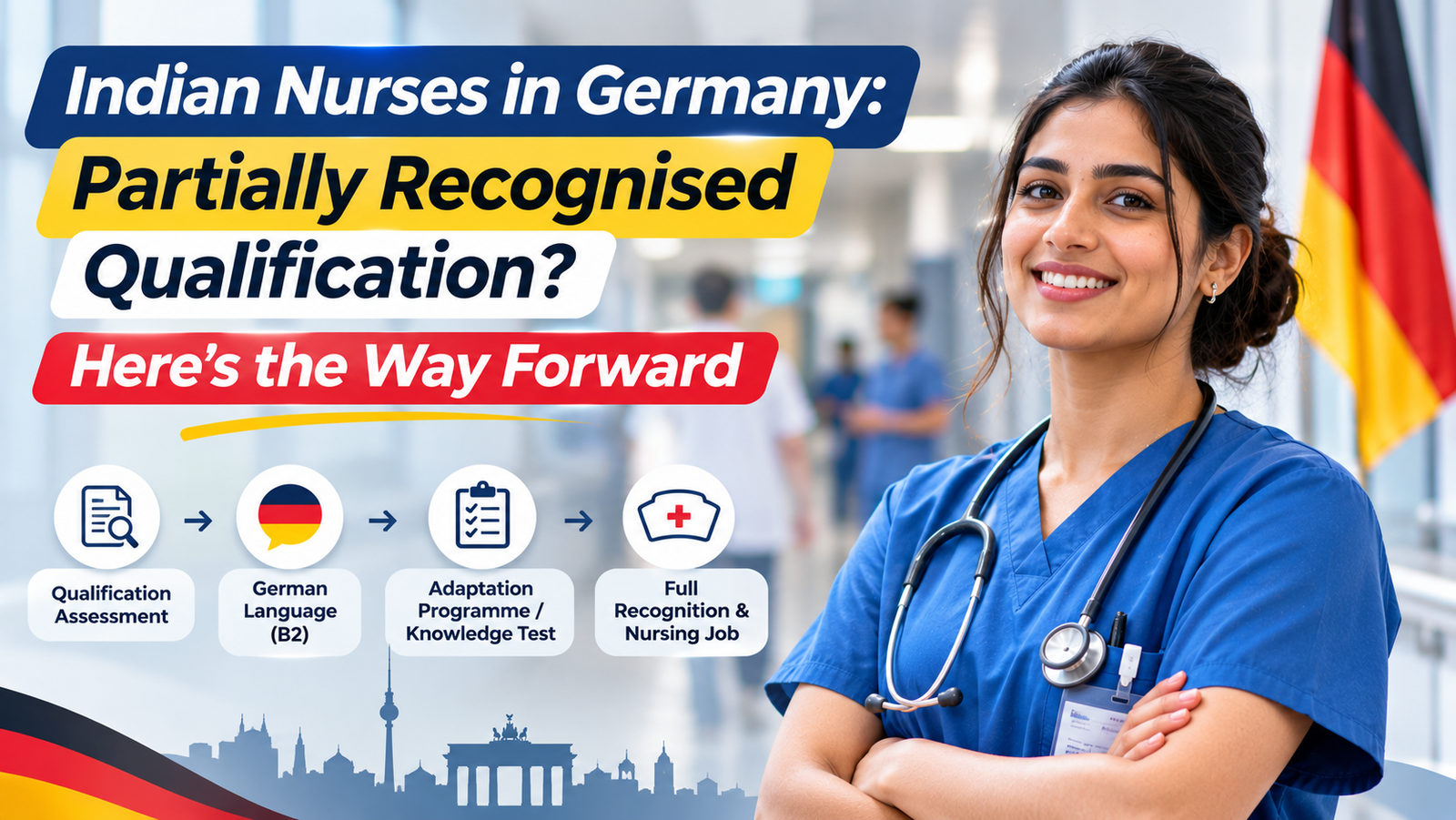
How can Indian nurses apply for jobs in Germany when their nursing qualifications are only partially recognised? The answer is encouraging: partial recognition does not necessarily end your opportunity to work in Germany. It means the German recognition authority has identified significant differences between your nursing education and the German reference qualification. You may be able to address those differences through an adaptation period (Anpassungslehrgang) or a knowledge test (Kenntnisprüfung) while following the appropriate immigration route.
There is one crucial distinction. Nursing is a regulated profession in Germany. An Indian nurse with only partial recognition generally cannot independently practise as a fully licensed German nursing professional or use the protected professional title until the competent authority grants professional authorisation. However, eligible candidates may work in an appropriately permitted assistant or supervised role while completing recognition measures, depending on their visa, employer and professional restrictions.
For applicants who already have a German partial-recognition notice (Defizitbescheid), a recognition visa under Section 16d(1) of the Residence Act can be relevant. A different route, the recognition partnership under Section 16d(3), can allow certain candidates to enter Germany with an eligible employer and complete the recognition process after arrival. The two pathways have different documentation and timing rules; they should not be treated as interchangeable.
Europe Careers recommends preparing German to B2 before serious nursing recruitment and recognition steps. Official guidance identifies B2 for nursing professional recognition, while some recognition visa routes, including the recognition partnership, have a lower A2 entry threshold. An A2 visa threshold does not mean that an applicant may practise independently as a licensed nurse at A2.
Quick answer: Indian nurses with partial recognition can seek a German employer willing to support an adaptation programme or knowledge-test pathway, prepare the recognition notice and training plan, apply for the appropriate Section 16d visa and work only within their permitted scope while completing the remaining requirements. After full recognition, B2 German and professional authorisation, they can seek a qualified nursing role and the appropriate skilled-worker residence permit.
What does partial recognition of an Indian nursing qualification mean?
Germany assesses foreign nursing qualifications against the relevant German nursing profession. The competent recognition authority reviews the candidate’s education, clinical practice and other qualifying evidence. If substantial differences remain, it issues a notice identifying the missing elements and the measures available to address them.
This outcome is often described as partial recognition, a deficit notice or Defizitbescheid. It does not necessarily mean that the candidate’s Indian qualification is invalid. It means full equivalence or all licensing conditions have not yet been established under German rules.
The notice is valuable because it tells you what is missing. A candidate may need further supervised practice, additional theoretical learning or a knowledge test. German language, health suitability and personal reliability requirements can also need separate proof.
| Recognition outcome | Meaning | What to do next |
|---|---|---|
| Full recognition and licensing conditions met | Qualification is equivalent and professional requirements are satisfied | Apply for professional authorisation and eligible nursing employment |
| Partial recognition / deficits identified | Substantial differences remain | Plan adaptation period or knowledge test |
| Recognition assessment not started | No final German equivalence decision yet | Consider applying from India or an eligible recognition partnership |
| Insufficient documentation | Authority cannot properly assess evidence | Supply requested records and translations |
| Negative outcome | Recognition requirements not met | Seek guidance on review, alternative qualification or assistant recognition |
Can an Indian nurse work in Germany with only partial recognition?
Yes, under certain conditions, but not automatically as a fully licensed nurse. Germany allows eligible third-country professionals to enter for qualification measures and, where their residence permission and employer arrangements allow it, to work during the recognition process.
The work may be described as nursing assistance, support work or supervised duties. The exact scope depends on professional law, the employment contract, the training or recognition plan and immigration authorisation. Employers must not assign tasks reserved for fully authorised nursing professionals to someone who lacks the necessary licence.
A hospital may consider an international applicant for a position that combines employment with an adaptation programme. Another institution may require completion of the knowledge test before offering a fully qualified nursing role. The safest approach is to ask the employer to describe the job title, permitted responsibilities, salary, recognition support and the intended visa category in writing.
| Activity | Possible before full recognition? | Important limitation |
|---|---|---|
| Apply to German hospitals or care employers | Yes | Employer decides whether to consider candidate |
| Participate in adaptation training | Yes, if arranged and authorised | Must match recognition requirements |
| Take the knowledge test | Yes, through applicable procedure | Exam registration and eligibility rules apply |
| Perform permitted assistant duties | Potentially | Only within residence and professional scope |
| Work independently as a fully licensed nurse | Generally no | Full recognition and professional authorisation required |
| Move to qualified nursing employment after licensing | Yes, if other conditions met | Appropriate employment residence title needed |
Which Indian nursing qualifications may be considered for German recognition?
Indian candidates commonly ask whether GNM, BSc Nursing, Post Basic BSc Nursing or MSc Nursing can lead to German nursing employment. There is no universal rule that every graduate from a named Indian course automatically receives full recognition.
German authorities assess the actual qualification, curriculum, clinical training, duration, professional status and relevant evidence against the German reference occupation. Work experience and further education may be considered as part of an individual equivalence assessment.
For example, two BSc Nursing graduates may receive different outcomes if their documentation, practical training records or other relevant circumstances differ. An MSc does not automatically remove deficits from an underlying qualification. Applicants should submit accurate records rather than rely on informal claims that one Indian degree always passes or always fails.
| Indian qualification | Possible recognition route | Main point |
|---|---|---|
| GNM | Individual assessment | Detailed theory and clinical-hour evidence matters |
| BSc Nursing | Individual assessment | Degree title alone does not guarantee equivalence |
| Post Basic BSc Nursing | Individual assessment | Prior and subsequent training may need documentation |
| MSc Nursing | Individual assessment of relevant qualifications | Postgraduate study does not automatically confer German licence |
| Nursing work experience | May support equivalence assessment | Experience should be documented and relevant |
How to apply for nursing jobs in Germany after receiving a Defizitbescheid
Once you receive a partial-recognition notice, the next step is to turn that document into a practical employment and qualification plan. Begin by reading the notice carefully. Identify the listed deficits, the compensation measures offered and any deadlines or instructions.
Then look for employers who explicitly recruit internationally trained nurses undergoing recognition. Hospitals, residential care facilities and other healthcare providers may have structured adaptation programmes, partnerships with training institutions or experience supporting overseas staff.
When contacting an employer, state that you have a German recognition notice and explain whether you are seeking an adaptation programme, a knowledge-test preparation route or a role combining supervised work and qualification measures. Include the relevant documents and ask whether the employer can support the required training plan.
A promising employer should be able to discuss the role, recognition support, working conditions and the immigration steps clearly. Do not accept an offer based solely on a verbal promise that you can start as a registered nurse immediately.
| Application stage | What the nurse prepares | What the employer should clarify |
|---|---|---|
| Review deficit notice | List missing modules or practice areas | Whether programme can address them |
| Prepare German CV | Show education, placements and experience | Suitability for available role |
| Submit recognition records | Defizitbescheid and supporting certificates | Recognition support available |
| Interview | Explain language and clinical readiness | Job duties and supervision |
| Agree qualification plan | Choose adaptation or exam route | Training provider, schedule and cost |
| Prepare immigration file | Visa and funding evidence | Contract, pay and employer documents |
| Complete recognition | Finish approved measures | Future licensed nursing position |
Where can Indian nurses find employers offering recognition support?
Focus on employers that understand international nursing recognition rather than simply advertising generic nursing vacancies. A genuine employer should know that nursing is regulated and that partial recognition requires a structured path to professional authorisation.
Search hospital career pages, nursing-home career sections and vacancies that mention Anerkennung, Anpassungslehrgang, Kenntnisprüfung, Pflegefachkraft in Anerkennung or internationale Pflegekräfte. The exact wording varies by employer and state.
During the application, ask whether the employer has previously supported international nurses, whether a training provider is involved and whether the company can offer a written adaptation plan. Ask who pays examination fees, language courses, relocation costs and other expenses. Do not assume all costs are covered.
Europe Careers can help candidates understand nursing recruitment expectations, prepare their applications and organise a more informed employer search. An employer’s suitability and any job offer still require independent verification.
Which visa can Indian nurses use when they have partial recognition?
The most relevant route for many applicants with a formal deficit notice is the visa for recognition of foreign professional qualifications under Section 16d(1). It is intended for people who need additional qualification measures in Germany to achieve full recognition.
Applicants generally need evidence of the partial-recognition outcome and a suitable qualification measure. Where practical training is provided by a company, a professional development plan may be necessary, and the relevant employment and immigration approvals must be considered. Proof of financing and language ability is also important.
A second option is a recognition partnership under Section 16d(3). It is designed for eligible candidates who have a qualifying foreign qualification, an eligible employer and a written agreement to complete recognition after entry. Importantly, this route generally does not require a prior German partial-recognition notice. It is therefore particularly relevant to candidates who have not yet completed the German recognition assessment.
| Visa route | Typical applicant | Key distinction |
|---|---|---|
| §16d(1): recognition of foreign qualification | Applicant already has a deficit notice | Qualification measure addresses identified differences |
| §16d(3): recognition partnership | Eligible applicant and employer agree to complete recognition after entry | Prior German recognition procedure generally not necessary |
| §18a: skilled-worker employment | Fully recognised and professionally authorised nurse with suitable job | Normal qualified nursing employment route |
| Other residence routes | Case-specific | Must match actual purpose and eligibility |
Neither route guarantees visa approval. The correct option depends on the candidate’s documentation, employer, qualification measure and the applicable German mission’s instructions.
What is the difference between a recognition visa and a recognition partnership?
The terms sound similar but describe different pathways. The recognition visa under Section 16d(1) is commonly used after the competent authority has identified qualification deficits. The applicant then travels to Germany to complete an approved qualification measure.
A recognition partnership under Section 16d(3) lets eligible candidates and employers agree to carry out recognition after arrival. The applicant must hold a qualifying foreign qualification recognised in the country of training, meet the route’s language requirements and have a suitable employer committed to the recognition process.
In regulated professions such as nursing, the partnership does not remove the professional licence requirement. A nurse may be restricted to assistant duties until full authorisation is obtained. The employer must provide the opportunity to complete necessary recognition measures.
| Question | Recognition visa §16d(1) | Recognition partnership §16d(3) |
|---|---|---|
| Is a prior deficit notice needed? | Generally yes | Generally no |
| Is a qualification plan needed? | Yes, for relevant measure | Employer agrees to support recognition |
| German at entry | Route and measure dependent | At least A2 statutory threshold |
| Can you practise independently as nurse? | Not without licence | Not without licence |
| Employer involvement | May be required for practical measure | Written partnership and suitable employer essential |
| Final goal | Complete deficits and obtain full recognition | Complete recognition after arrival |
How much German language proficiency do partially recognised nurses need?
German language is central to patient safety, nursing documentation, clinical handovers and communication with doctors and families. Official federal guidance states that professional recognition for nurses generally requires B2 German.
At the same time, the recognition partnership visa under Section 16d(3) lists a minimum A2 language threshold. Other recognition measures can have their own requirements. The fact that A2 may satisfy a particular immigration entry rule does not mean that A2 is sufficient to pass a nursing adaptation programme, obtain a professional licence or perform independent nursing duties.
Europe Careers recommends B2 as the preparation standard for Indian nursing candidates. Strong B2-level communication is valuable for job interviews, medical terminology, patient interaction and the final professional recognition stage.
| Stage | Language expectation | Why it matters |
|---|---|---|
| Recognition partnership entry | At least A2 under route rules | Immigration threshold, not nursing licence |
| Recognition visa and qualification measure | Check specific route and programme | Provider may require higher German |
| Hospital interview | Employer-specific | Practical listening and speaking assessment |
| Nursing professional recognition | Generally B2 | Patient safety and professional authorisation |
| Europe Careers recommended preparation | B2 | Career and recognition readiness |
Useful preparation includes nursing vocabulary, patient admission questions, documentation terms, explaining medication instructions within permitted duties, clinical handovers and polite communication with colleagues.
What is an adaptation period for foreign nurses in Germany?
An Anpassungslehrgang is an adaptation or compensation measure designed to address the substantial differences identified during recognition. It may combine supervised practical work, structured learning and assessment, depending on the authority’s notice and the training provider’s arrangements.
For example, a nurse whose curriculum lacks certain documented clinical practice areas may be required to complete additional supervised experience. Another candidate may need theoretical modules related to German nursing standards, patient care or professional responsibilities.
The length is not identical for everyone. It depends on the deficits identified, the state, the provider and the candidate’s individual training history. Avoid advertisements promising that every nurse can complete recognition in a fixed number of weeks.
After completing the prescribed adaptation measure, the candidate submits the required proof to the competent authority. Full professional authorisation still depends on satisfying all other conditions, including language and personal suitability.
What is the Kenntnisprüfung for Indian nurses?
The Kenntnisprüfung is a knowledge test that can be used to demonstrate that a foreign-trained nurse has the knowledge and skills needed for the German reference profession. It is an alternative compensation pathway where permitted by the competent authority.
Preparation may involve German nursing law, care planning, patient assessment, clinical procedures, hygiene, documentation, communication and other relevant topics. The exact examination structure and arrangements depend on the competent state authority and examination provider.
The knowledge test is not the same as a general German language examination. Strong German is still necessary to understand questions, explain clinical decisions and communicate safely. A candidate should ask the authority and employer which test is required, what preparation is available and how registration works.
| Aspect | Adaptation period | Knowledge test |
|---|---|---|
| Main approach | Structured learning and practical compensation | Demonstrate required knowledge and skills in assessment |
| Best fit | Candidates who benefit from guided workplace training | Candidates ready for a formal knowledge assessment |
| Duration | Depends on individual deficits and provider | Preparation and test scheduling vary |
| German demands | Clinical communication throughout | Understand and explain nursing scenarios |
| After successful completion | Submit proof for recognition | Submit exam result for recognition |
| Guarantees licence? | No, other conditions must be met | No, other conditions must be met |
Should Indian nurses choose an adaptation programme or a knowledge test?
There is no universal best choice. A candidate with extensive recent clinical experience and strong German may feel comfortable preparing for a knowledge test. Another candidate may prefer an adaptation programme that provides structured practice in a German hospital or care facility.
Consider the exact deficits, cost, schedule, support available from the employer, personal learning style and confidence with German nursing terminology. A programme that looks shorter on paper is not necessarily better if the candidate lacks sufficient preparation.
Ask the recognition authority which compensation measures are available in your case. Discuss the practical implications with the employer before signing a contract. Where the rules allow different options, choose based on a realistic assessment of your readiness rather than an agent’s promise of guaranteed success.
Can Indian nurses start working as nursing assistants during recognition?
Some candidates may work in an assistant or support capacity while pursuing full nursing recognition. The recognition partnership route specifically acknowledges that applicants to regulated healthcare professions may work as assistants until they receive the required professional licence.
However, the job must be lawful under the candidate’s actual residence title, employer arrangement and professional rules. A position labelled “nurse” in an advertisement is not enough. The contract and the permitted duties should clearly distinguish assistant responsibilities from tasks reserved for licensed professionals.
Applicants should confirm who supervises their work, what training they will receive and whether the role is connected to an approved recognition plan. They should also clarify how the job title and salary will change after professional authorisation.
What documents should Indian nurses prepare for partial recognition jobs?
Accurate documentation is often the difference between a smooth application and repeated requests for clarification. German authorities need to understand what the candidate studied, how much practical training was completed and whether the qualification is valid in the country of training.
Gather original documents and prepare certified translations or copies where required by the competent authority. Do not assume that every German state or visa category uses the same checklist.
| Document | Purpose |
|---|---|
| Passport and identity records | Confirm applicant identity |
| GNM/BSc Nursing qualification and certificates | Show nursing education |
| Detailed transcripts and syllabus | Compare theory subjects |
| Clinical training and hours records | Verify practical learning |
| Indian nursing registration | Show professional standing where applicable |
| Experience certificates | Document relevant work history |
| Defizitbescheid / recognition notice | Identify remaining qualification gaps |
| German language certificate | Demonstrate required language proficiency |
| German CV and application letter | Support employer recruitment |
| Job offer or employment contract | Confirm role and conditions |
| Adaptation or examination registration | Show planned recognition measure |
| Employer training plan / partnership agreement | Required for relevant visa route |
| Funding and insurance evidence | Support visa and residence requirements |
For an applicant who has not yet begun recognition, the employer may instead consider the recognition partnership route. That route has its own qualification-verification and agreement requirements.
How to write a German CV when nursing recognition is incomplete
Recruiters appreciate clarity. Put your nursing qualification, Indian registration status, clinical experience and German language level near the top. State the recognition status accurately: for example, “Anerkennungsverfahren: Defizitbescheid liegt vor” if you genuinely have a deficit notice.
Include relevant clinical placements and work areas, such as general medicine, surgery, geriatrics or other units where you have documented experience. Avoid claiming German professional registration or a licence you have not received.
A useful application message can explain that you are seeking a nursing recognition position with an adaptation programme or preparation for the knowledge test. Attach the notice if requested and indicate your availability for an interview.
Tailor each application to the employer. A hospital with a structured international nurse programme may value different experience from a residential care facility. A precise CV and realistic language description are more convincing than a generic template.
What questions do German hospitals ask partially recognised nurses?
Employers may ask why you want to work in Germany, what nursing duties you performed in India, how you communicate with patients and whether you understand that full recognition is still required.
They may also ask how you plan to improve your German, whether you prefer adaptation training or the knowledge test and how you would handle a clinical situation under supervision. These questions are designed to assess motivation, practical knowledge and communication, not merely to check a certificate.
| German interview question | English meaning | Good preparation |
|---|---|---|
| Welche Ausbildung haben Sie abgeschlossen? | Which nursing qualification did you complete? | Explain GNM/BSc and training clearly |
| Haben Sie bereits einen Defizitbescheid? | Do you already have a deficit notice? | Describe your actual recognition status |
| Wie gut sprechen Sie Deutsch? | How well do you speak German? | State truthful CEFR level |
| Warum möchten Sie in Deutschland arbeiten? | Why do you want to work in Germany? | Connect to professional goals |
| Welche praktischen Erfahrungen haben Sie? | What practical experience do you have? | Give specific clinical examples |
| Sind Sie bereit, einen Anpassungslehrgang zu machen? | Are you willing to complete adaptation training? | Explain your recognition plan |
| Wie reagieren Sie, wenn Sie etwas nicht verstehen? | What do you do if you do not understand? | Emphasise clarification and patient safety |
How much do nurses earn during partial recognition in Germany?
Pay during recognition is not the same as a guaranteed salary for a fully licensed nursing professional. An applicant’s earnings depend on the employer, permitted job role, working hours, collective agreement, region and whether the arrangement is employment, a paid adaptation placement or another qualification measure.
Some employers may pay a salary during supervised assistant employment or practical adaptation. Others may have different financial arrangements for courses, examinations or training periods. There is no reliable single salary figure that every partially recognised Indian nurse will receive.
Ask for the gross monthly salary in writing and check whether it changes after full recognition. Also ask who pays for accommodation, insurance, language courses, examination fees, travel and document processing. A quoted gross salary should never be mistaken for net take-home pay.
| Pay question | What to verify |
|---|---|
| What is the exact gross monthly pay? | Written contract amount |
| What is the job title before recognition? | Assistant/supervised role versus licensed nurse |
| Is adaptation time paid? | Hours, conditions and any training agreement |
| Are exam and course fees covered? | Employer payment or employee responsibility |
| Does pay increase after licensing? | Written terms of qualified nursing position |
| Are housing and relocation included? | Actual costs, deductions and obligations |
How long does partial nursing recognition take in Germany?
The duration depends on the stage of the process. The initial recognition assessment is commonly described in official guidance as taking around three to four months once the authority has the necessary documents, but actual processing can vary with completeness and local workload.
After a deficit notice, the time needed for adaptation or a knowledge test depends on the identified gaps, course availability, exam dates, German language preparation and employer arrangements. Visa processing adds another variable.
Do not assume that an advertised “three-month recognition package” is an official nationwide timetable. The most useful planning method is to separate document preparation, authority assessment, employer recruitment, visa processing, qualification measures and final professional authorisation.
| Stage | What affects duration |
|---|---|
| Collect Indian education records | Availability of syllabus, hours and certificates |
| Recognition authority assessment | Complete file and state processing |
| Employer recruitment | Vacancies, interviews and contract preparation |
| Visa application | Mission appointments and document review |
| Adaptation or knowledge test | Individual deficits and programme capacity |
| Final licensing | Authority checks successful compensation and other conditions |
What happens after an Indian nurse completes the adaptation programme?
After successfully completing the prescribed measure or passing the required knowledge test, the candidate submits the relevant evidence to the competent German recognition authority. The authority checks whether the substantial differences have been resolved and whether the remaining licensing conditions are met.
These can include German language ability, health suitability and personal reliability. Once full professional recognition and authorisation are granted, the candidate may be able to take up employment as a qualified nursing professional.
At that point, a candidate who holds a recognition-related residence permit may need to apply for the appropriate skilled-worker residence title, commonly under Section 18a, with a suitable job offer. The change is not automatic simply because the adaptation course ended.
Applicants should coordinate with the employer and foreigners authority before the existing residence permit expires.
Can Indian nurses switch to a skilled-worker visa after full recognition?
Yes, where the statutory conditions are met. The normal skilled-worker employment route for vocationally qualified nurses generally requires full professional recognition, the necessary licence and a concrete offer of qualified employment.
A nurse who completes the recognition process may be able to continue with the same employer in a fully qualified role or apply to another eligible employer. The residence permit must match the intended work.
The recognition partnership pathway also provides for a transition after successful recognition. Where a qualifying job is not yet available, the candidate should examine the job-search options applicable to their exact status rather than assume indefinite residence.
Can partially recognised nurses apply directly for the EU Blue Card?
The EU Blue Card is not the normal route for regulated nursing employment. Germany’s official nursing guidance explicitly states that the EU Blue Card does not apply to nursing professionals.
For Indian nurses, the practical routes usually involve professional recognition, the appropriate Section 16d recognition residence pathway while addressing deficits and a qualified skilled-worker residence title after licensing. Applicants should not base a nursing migration plan on an advertisement promising a Blue Card simply because they hold a BSc or MSc Nursing degree.
Can nurses with partial recognition bring their families to Germany?
Family reunification depends on the specific residence title, financial situation, family relationship and applicable immigration requirements. Partial recognition or an employer’s letter alone does not automatically grant a visa to a spouse or children.
Before making family plans, confirm the exact recognition-related residence route, accommodation, health insurance and financial conditions. After obtaining full recognition and qualified employment, some families may find it easier to plan long-term relocation, but each application is assessed separately.
How can Indian nurses identify genuine German recruitment offers?
Genuine healthcare recruitment should be transparent about the employer’s identity, professional recognition and the actual duties permitted before licensing. A recruiter who claims that a partially recognised nurse can work independently as a registered nurse without further authorisation is giving a serious warning sign.
Check the employer’s official website, physical address and contact details. Ask for a written contract and a clear explanation of the adaptation or knowledge-test arrangement. Confirm who pays for language classes, examinations, accommodation and relocation, and understand any repayment clauses before signing.
Be cautious of guaranteed visa promises, unrealistic salaries, pressure to pay immediately or requests for original documents without proper explanation. German professional recognition and visa decisions are made by competent authorities, not by recruitment agents.
| Positive sign | Warning sign |
|---|---|
| Employer identifies exact job and duties | Vague promise of immediate registered-nurse status |
| Written adaptation or recognition plan | No explanation of deficits or licensing |
| Transparent salary and fees | Unexpected deductions or hidden costs |
| Verifiable employer contact details | Only anonymous messaging accounts |
| Realistic visa and processing expectations | Guaranteed visa or guaranteed recognition claims |
| Clear German language requirements | Claim that German is never needed |
How Europe Careers helps Indian nurses with partial recognition
For many Indian nurses, the challenge is not a lack of professional ambition. It is understanding how an Indian nursing qualification is assessed in Germany, what a deficit notice means and which employer and residence route fits the next stage.
Europe Careers helps Indian healthcare candidates understand nursing opportunities in Germany, prepare for German-language expectations, organise applications and approach the recognition journey with a practical plan. Our guidance focuses on the difference between a partially recognised qualification and full authorisation to practise, so candidates can prepare for the correct roles rather than misunderstand their status.
We recommend German B2 preparation for nurses because patient communication, handovers and clinical training require strong real-world language skills. We also help candidates think through employer interviews, documentation, adaptation versus knowledge-test choices and the transition to qualified employment.
The appropriate recognition decision, professional licence and immigration permission remain the responsibility of the relevant German authorities. A well-prepared application can reduce avoidable confusion, but no consultant can promise a particular approval.
Your German nursing career can move forward after partial recognition
Have a German Defizitbescheid, or are you planning to start nursing recognition from India? Europe Careers can help you understand your next steps, German B2 preparation and nursing job application requirements.
Speak with Europe Careers about nursing opportunities in Germany
Practical checklist before applying from India
Start by identifying your qualification and the German state in which you intend to work. Find the relevant recognition authority and understand whether you should obtain a formal assessment first or explore a recognition partnership with an eligible employer.
Prepare a clear CV, transcripts, nursing registration records and detailed clinical training evidence. Begin German language learning early, ideally targeting B2 before interviews and recognition measures. If you already have a deficit notice, use it to ask employers about the specific adaptation or exam support available.
Before accepting an offer, confirm the job title, legal duties, salary, visa category, training provider, cost responsibilities and what happens after full recognition. Keep copies of every agreement and submit applications through the appropriate official channels.
For related guidance, explore nursing jobs in Germany for Indian nurses, the German nursing recognition process and nursing salaries in Germany.
Frequently asked questions about partially recognised Indian nurses in Germany
Final advice: Partial recognition is a step in the process, not the end of your German nursing career
Indian nurses who receive partial recognition still have meaningful options. The deficit notice identifies what remains to be completed, and the appropriate recognition route may allow an eligible candidate to undertake an adaptation programme or knowledge test in Germany. Some candidates can work in legally permitted assistant or supervised roles while moving toward full professional recognition.
The most important safeguards are understanding that nursing is regulated, selecting the correct Section 16d pathway, confirming employer support and building German language proficiency to B2. After full recognition and professional authorisation, a suitable qualified nursing job can open the next skilled-worker residence step.
Europe Careers encourages nurses to make informed decisions using their actual documents, recognition status and employer terms. If you are preparing to move from India to Germany, contact Europe Careers to discuss nursing career preparation and German-language support.
Information reviewed against Germany’s official nursing and professional recognition guidance in November 2026. Requirements depend on the German state, profession, residence route and individual recognition decision.



[…] how Indian nurses can apply with partially recognised qualifications and nursing jobs in Germany for Indian […]