
Can Indian Professionals Apply for a Germany Opportunity Card Without Having a Job Offer from a German Employer?
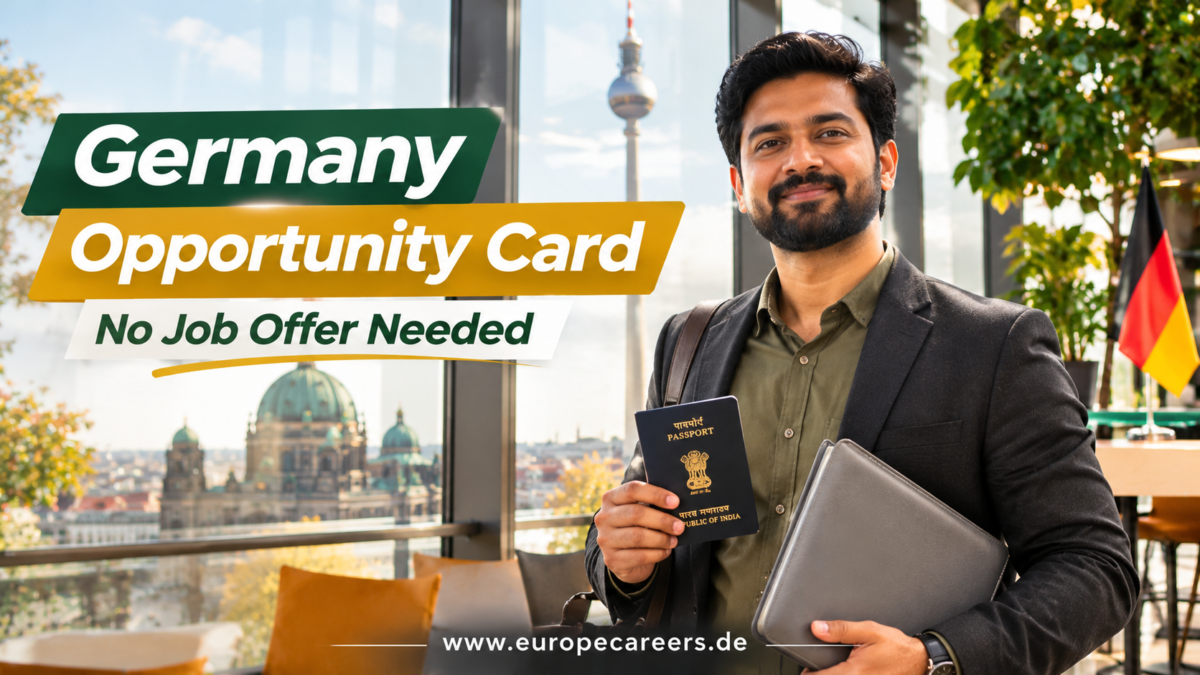
Updated November 2026 | A detailed guide for Indian graduates, engineers, IT professionals and vocationally qualified applicants considering the Germany Opportunity Card (Chancenkarte).
Can Indian professionals apply for a Germany Opportunity Card without having a job offer from a German employer? Yes. That is one of the main reasons Germany introduced the Opportunity Card, also called the Chancenkarte. It gives eligible non-EU professionals a legal route to enter Germany and search for qualified employment without first securing a German employment contract.
But an Opportunity Card is not an open invitation to move to Germany without qualifications, funds or a realistic job-search plan. Applicants must meet one of two eligibility pathways, demonstrate sufficient financial resources and satisfy the applicable visa requirements. The initial card generally permits a stay of up to one year to look for qualified employment or relevant recognition measures.
Indian applicants can qualify directly if their degree or vocational qualification meets the German skilled-worker recognition rules. Alternatively, eligible applicants with a qualifying foreign degree or vocational qualification can use a points-based system requiring at least six points, along with minimum German A1 or English B2 language evidence.
For 2026, official German guidance lists a financial benchmark of €1,091 per month. That is €13,092 for a full 12 months as a simple illustration, although applicants should verify the current figure, accepted financial evidence and intended duration at the time they apply. A blocked account or a formal declaration of commitment may be used where accepted.
Europe Careers recommends German B2 as a practical preparation target for candidates serious about building a career in Germany. This is our recommended standard for interviews and workplace integration, not a claim that B2 German is legally compulsory for every Opportunity Card applicant.
Quick answer: No German job offer is required to apply for the Opportunity Card. You can qualify through a fully recognised qualification or a six-point pathway. You must still prove your qualifications and living-cost funding, meet the applicable language rules and submit a complete visa application. Once in Germany, the search card generally allows part-time work averaging up to 20 hours per week and qualified trial work within the permitted limits. A regular skilled job requires the appropriate subsequent residence permit.
What is Germany’s Opportunity Card (Chancenkarte)?
The Opportunity Card is a residence title under Section 20a of Germany’s Residence Act. It was introduced to help qualified people from outside the European Union come to Germany to search for skilled employment. Rather than requiring a signed full-time contract before arrival, the route evaluates whether the applicant has the education, skills, language ability and financial means to conduct a genuine job search.
For an Indian professional, the practical attraction is the ability to attend interviews in Germany, meet employers in person, explore suitable vacancies and assess workplace expectations directly. This may be useful in industries where employers prefer face-to-face interviews or practical assessments.
It is important to understand what the card is not. It is not a guaranteed employment scheme, not permanent residence, not a blanket permission for unlimited full-time work and not a substitute for professional licensing in regulated occupations.
| Opportunity Card feature | General position | What Indian applicants should know |
|---|---|---|
| Purpose | Search for qualified employment or suitable recognition measures | A job offer is not required at application |
| Initial validity | Up to one year | Duration depends on approval and circumstances |
| Qualification routes | Recognised skilled-worker route or points route | Different requirements apply |
| Financial means | Must show sufficient support | 2026 benchmark €1,091 per month |
| Part-time work | Up to 20 hours weekly on average | Not unrestricted full-time employment |
| Trial employment | Up to two weeks per trial under the applicable rules | Trial must meet qualified or recognition-related criteria |
| After job offer | Change to suitable employment residence title | Conversion is not automatic |
Do Indian applicants need a German employer or job contract before applying?
No. The official German Missions in India describe the Opportunity Card as a route for people who intend to work in Germany but have not yet received a job offer or employment contract. This makes it fundamentally different from many employment visas that require a concrete job offer.
However, no job offer does not mean no job-market research. The German Missions in India warn that applicants who arrive without researching available vacancies or potential employers often struggle to find work. A sensible applicant should identify target roles, check whether their qualification is suitable and begin contacting employers before departure.
If you already have a suitable full-time job offer, an employment visa or EU Blue Card may be more appropriate than the Opportunity Card. Choosing the right visa can save time and unnecessary living expenses.
Who is eligible for the Germany Opportunity Card from India?
Eligibility begins with the applicant’s qualification and the pathway under which they apply. Germany recognises two main options. The first is for people already considered skilled workers under German immigration law. The second is for applicants who meet a qualifying foreign education, language and points combination.
A university degree is not compulsory in every case. A qualifying vocational qualification may also support eligibility, provided the rules for the chosen route are met. On the other hand, having several years of work experience without a qualifying formal education does not automatically satisfy the Opportunity Card requirements.
| Applicant profile | Potential route | Important check |
|---|---|---|
| Indian university graduate with German-comparable degree | Direct skilled-worker route | Degree and institution comparability |
| Indian vocational graduate with fully recognised qualification | Direct skilled-worker route | German recognition decision |
| Indian graduate with qualifying foreign degree but no German equivalence | Six-point route | State recognition in country of training, language and points |
| Vocational graduate with at least two years of qualifying training | Six-point route | Formal qualification and relevant verification |
| Professional with experience but no qualifying formal education | Not automatically eligible | Qualification requirement still applies |
| Nurse, doctor or other regulated professional | Case-specific | Recognition and professional licence still matter |
The two eligibility routes explained: recognised qualification vs six points
Route one: recognised skilled worker. If you have a degree or vocational qualification obtained in Germany, or a foreign qualification that is recognised or comparable as required in Germany, you may qualify for the Opportunity Card without scoring six points. Under this route, Germany does not impose a general language-certificate requirement for the Opportunity Card itself, although employers may expect German.
Route two: points-based applicant. If your foreign qualification is not fully recognised in Germany, you may still qualify if you have a formal academic degree or a vocational qualification meeting the route’s conditions, prove at least German A1 or English B2 and earn six or more points.
For the points route, the foreign qualification must be recognised in the country in which it was obtained. Vocational training generally must have lasted at least two years. Supporting evidence can include Anabin or a ZAB statement for academic qualifications and the appropriate ZAB digital qualification information for vocational training.
| Requirement | Direct skilled-worker route | Six-point route |
|---|---|---|
| German job offer | Not required | Not required |
| Formal qualification | German or appropriately recognised/comparable qualification | Qualifying foreign degree or at least two-year vocational training |
| Minimum points | No points threshold | At least six points |
| Minimum language for card | No general language proof required | German A1 or English B2 |
| Financial proof | Required | Required |
| Professional licensing | Separate where regulated | Separate where regulated |
| Job search purpose | Qualified employment or relevant recognition pathway | Qualified employment or relevant recognition pathway |
How does Germany’s Opportunity Card points system work?
The six-point system applies only to the second eligibility route. Applicants earn points for factors that Germany associates with successful labour-market integration, such as partial recognition of qualifications, relevant professional experience, German language ability, age and certain connections to Germany.
These points are not a replacement for the basic requirements. A candidate with six points but without a qualifying formal education or the required minimum language evidence is not automatically eligible. The official calculator and consular review determine whether evidence supports the claimed score.
| Points criterion | Points | Important qualification |
|---|---|---|
| Partial equivalence of foreign qualification | 4 | Formal German partial-recognition result |
| German language A2 | 1 | Above baseline A1 |
| German language B1 | 2 | Recognised proof |
| German language B2 or above | 3 | Recognised proof |
| Relevant experience: 2 years in last 5 | 2 | Experience related to qualification |
| Relevant experience: 5 years in last 7 | 3 | Documented qualifying experience |
| Age up to 35 under official rule | 2 | Check exact age cutoff in calculator |
| Age in the next eligible bracket | 1 | Check official calculator |
| Qualification in shortage occupation | 1 | Must fit official category |
| English C1 or native speaker | 1 | Additional point subject to evidence |
| Qualifying previous stay in Germany | 1 | At least 6 months, with applicable restrictions |
| Eligible spouse/partner also applying | 1 | Subject to official partnership criteria |
German A1 or English B2 can satisfy the basic language condition for the points route but does not automatically generate extra points at those baseline levels. Higher German skills can materially improve the score, which is one reason B2 preparation can be valuable.
Opportunity Card points examples for Indian professionals
Consider an Indian engineer aged 30 who has a qualifying degree, documented two years of relevant professional experience within the required period and certified B2 German. The indicative points are two for age, two for experience and three for German: seven points. The candidate still needs the basic education and financial conditions.
Another example is an applicant aged 38 with a qualifying vocational qualification, documented five years of relevant experience, C1 English and a qualification in an officially designated shortage occupation. Depending on the exact age rule and evidence, this combination could reach the six-point threshold. These examples are for understanding the system, not visa pre-approval.
Applicants should use the official Opportunity Card self-check rather than relying on a recruitment advertisement’s informal score. Authorities may decline to award points when documentation is missing or a claimed qualification does not meet the legal definition.
Can Indian professionals apply without speaking German?
Sometimes, yes. On the direct recognised-skilled-worker route, the Opportunity Card itself does not impose a general German language-certificate requirement. On the points route, the basic language condition can be met with English B2 instead of German A1, provided the accepted evidence is supplied.
However, being eligible to apply without German is different from finding a job without German. Employers may need staff who can communicate with colleagues, customers or patients in German. The German Missions in India specifically encourage jobseekers to research employment prospects and highlight the practical value of German language skills.
Europe Careers recommends B2 German as the career-preparation target, especially for applicants planning long-term professional growth. It is not the statutory minimum for every visa applicant. In regulated healthcare roles, separate professional language requirements may apply.
| Situation | Legal/route minimum | Practical advice |
|---|---|---|
| Recognised skilled-worker Opportunity Card | No general language certificate for card | German still improves job prospects |
| Six-point Opportunity Card | German A1 OR English B2 | B2 German recommended |
| Extra points for German B1 | 2 points | Useful for job search |
| Extra points for German B2 | 3 points | Strong interview and workplace advantage |
| Regulated healthcare occupation | Separate licensing requirements | Confirm professional German standards |
How much money is needed for the Opportunity Card in 2026?
Germany requires proof that you can cover your living expenses while searching for employment. According to the official 2026 guidance, the benchmark is €1,091 per month. For an intended 12-month stay, multiplying that figure by 12 gives €13,092. This is a planning illustration, not a promise that the same amount will apply in 2027 or every individual application.
Accepted evidence can include a blocked account (Sperrkonto) or a qualifying formal declaration of commitment from a person in Germany. In some cases, qualifying part-time income may be considered under the relevant rules. The applicant should follow the German mission’s current checklist and the portal’s instructions.
Remember that the financial requirement is not the same as the total cost of relocating. You may also need to budget for flights, initial accommodation, deposit, insurance, transport, document services and emergencies.
| Planning item | Illustrative figure or consideration |
|---|---|
| 2026 monthly living-cost benchmark | €1,091 |
| 12-month illustration at 2026 rate | €13,092 |
| Blocked account | One possible financial proof method |
| Formal declaration of commitment | Another possible proof method if accepted |
| Travel, deposit and setup costs | Budget separately |
| 2027 application | Recheck current official benchmark before paying |
Can applicants use a blocked account instead of a job offer?
Yes. A blocked account is a financial evidence method, not an employment contract. It can help demonstrate that an applicant has sufficient money to support the planned job-search stay.
But having the required funds does not remove the need for qualification evidence, language proof where applicable, health insurance or a genuine job-search purpose. The German mission assesses the whole application.
Do not transfer money based on an unverified agent’s bank instructions. Use the recognised application process and verify financial requirements from official German sources before making payments.

Which documents do Indian applicants need for the Opportunity Card?
The German Missions in India use the Consular Services Portal to guide applicants through a personalised document checklist. Exact requirements depend on whether you apply as a recognised skilled worker or through the points system.
Applicants should prepare their identity, education and financial documents first. The German Missions in India also explain that applicants with Indian university degrees may need semester mark sheets and evidence about whether the programme was completed through regular/on-site study or an appropriately approved distance-learning route.
| Document | Why it matters |
|---|---|
| Valid Indian passport | Identity and travel validity |
| Academic degree or vocational certificate | Formal qualification |
| Semester mark sheets and detailed education records | Degree verification |
| Anabin evidence or ZAB Statement of Comparability | Qualification status where applicable |
| ZAB digital vocational qualification information | Relevant points-route vocational evidence |
| German recognition or partial-recognition decision | Where applicable |
| Language certificate | German A1/English B2 for points route; higher for points |
| Experience letters and employment contracts | Document relevant work history |
| German or English CV | Show career history and target roles |
| Financial evidence | Prove sufficient living costs |
| Health insurance proof | Cover required period from entry |
| Additional consular documents | Follow personalised portal checklist |
Incomplete files can delay a decision. The German Missions in India reserve the right to request additional documents or verify certificates. Providing every document does not guarantee visa approval.
How can Indian professionals check whether their degree is recognised?
Academic qualification assessment is one of the most important early steps. The Anabin database provides information on foreign universities and qualifications. For some applications, the university and degree comparability status can be used as evidence.
If the relevant qualification cannot be established through the available Anabin entries, a ZAB Statement of Comparability may be needed. For the points route, a foreign academic qualification must meet the requirement of being recognised in the country of training, with suitable evidence under the current rules.
Do not assume that an Indian university being well known automatically establishes German comparability. The exact institution, degree, study mode and supporting documentation can matter. Vocational qualifications follow different verification and recognition processes.
For applicants in regulated professions such as nursing or medicine, professional licensing is a separate issue. Academic comparability does not automatically give the right to practise a regulated occupation in Germany.
Can diploma holders and professionals without university degrees apply?
Yes, certain vocationally qualified professionals can apply without a university degree. The points route recognises qualifying vocational training of at least two years that is officially recognised in the country of training. The candidate must also satisfy the language, points and financial requirements.
That does not mean every short course, private training certificate or work-experience letter is sufficient. The applicant needs an eligible formal qualification and the required verification. A fully recognised vocational qualification may instead support the direct skilled-worker route.
For Indian diploma holders, the right question is not simply “Is my diploma accepted?” but “Does my exact programme meet the legal qualification criteria, and what documentary evidence can prove it?”
Can fresh graduates apply for the Germany Opportunity Card?
Potentially, yes. Work experience is not a universal prerequisite for the direct recognised-skilled-worker route. For the points route, professional experience is one way to earn points, but it is not the only category.
A younger applicant with strong German skills and other qualifying factors may reach six points without relying entirely on years of employment. Still, recent graduates should think carefully about how competitive they will be in Germany’s labour market and whether employers recruit entry-level candidates in their target field.
The visa creates an opportunity to search, not a promise that a company will offer a role. Fresh graduates may benefit from internships, practical projects, portfolio work or additional German preparation before travelling.
Can Indian IT professionals and engineers use the Opportunity Card?
IT professionals, mechanical engineers, electrical engineers, civil engineers and other qualified applicants may find the Opportunity Card relevant if they meet the formal criteria. Eligibility is based on the qualification and immigration route, not a general rule that a particular industry automatically qualifies.
For IT roles, employers may use English in some teams, but German can still broaden opportunities. For engineering, German is often valuable for site communication, safety procedures, documentation and customer-facing work.
Applicants should search real vacancies before applying, assess required software and technical standards, and identify whether the target role is regulated or requires particular professional recognition. A relevant qualification is only the starting point.
Read related Europe Careers guides on engineering jobs in Germany and IT jobs without German language skills.
How to apply for a Germany Opportunity Card from India
Start with an eligibility check. Determine whether your qualification is fully recognised/comparable in Germany or whether you must use the six-point route. If using points, calculate the score using the official criteria.
Confirm qualification evidence. Check Anabin, ZAB or the relevant recognition route. Prepare detailed academic records and experience evidence as applicable.
Prepare language proof. For the points route, provide accepted German A1 or English B2 evidence. Consider progressing toward German B2 for stronger job prospects.
Arrange financial support. Calculate living costs for the intended stay and prepare accepted funding evidence. Confirm the current monthly benchmark.
Research German employers. Identify vacancies, refine your CV and begin networking. Explain your intended Opportunity Card status honestly.
Apply through the German Consular Services Portal. Complete the appropriate application, upload documents and follow instructions for review and appointment.
Attend the required appointment. Provide identity and biometric information, pay the applicable fee and answer any requested questions.
Travel only after approval. Arrange accommodation and insurance, then continue your job search in Germany within the conditions of your residence title.
| Application step | Key output |
|---|---|
| Eligibility check | Direct route or six-point route selected |
| Qualification verification | Anabin/ZAB/recognition evidence |
| Language preparation | Accepted certificate where required |
| Financial preparation | Sufficient funds documented |
| Job-market research | Target employers and realistic vacancies |
| Online visa submission | Complete Consular Services Portal application |
| Mission appointment | Identity and biometric verification |
| After arrival | Structured search for qualified employment |
Can you apply online from India?
Yes. Germany’s Consular Services Portal supports online Opportunity Card applications. The process guides applicants through a questionnaire, document uploads and preliminary review. An in-person appointment may still be required for identity checks and biometric data.
The German mission responsible for the applicant depends on their place of residence in India. Use the official mission’s instructions and personalised document checklist rather than a generic checklist copied from social media.
Do not treat an online eligibility calculator as visa approval. The final decision belongs to the competent German authorities.
Can Opportunity Card holders work part-time while looking for a job?
Yes. The initial job-search Opportunity Card generally allows secondary employment averaging up to 20 hours per week. This may help with living costs while the holder searches for a suitable qualified position.
The card also permits qualifying trial employment for up to two weeks at a time under the applicable conditions. The trial work must be connected to qualified employment, vocational training or a suitable recognition measure.
These permissions are limited. They should not be confused with an unrestricted right to start a normal full-time skilled position. Once a qualified job offer is obtained, the applicant should apply for the relevant employment residence permit before taking up work beyond the card’s conditions.
| Activity | General Opportunity Card rule | Practical warning |
|---|---|---|
| Look for skilled employment | Permitted | Research employers and job suitability |
| Secondary employment | Up to 20 hours per week on average | Check residence document |
| Qualified trial employment | Up to two weeks per trial | Must meet legal purpose and conditions |
| Unrestricted full-time employment | Not automatically permitted | Requires suitable employment title |
| Permanent residence | Not granted by card | Separate future requirements |
What happens after you find a German employer?
Finding a suitable employer is the turning point. A holder of the search Opportunity Card can apply at the local foreigners authority for the residence permit that matches the job and qualification.
Depending on the circumstances, that may be a skilled-worker residence permit, an EU Blue Card, a permit for professionally experienced workers or a recognition-related route. The employer may need to provide a contract and the official declaration of employment.
In some cases, where a qualified job is found but the conditions for another employment residence title are not yet met, a follow-up Opportunity Card may be possible for up to two additional years. It is a conditional extension, not an automatic extra two years for everyone.
Europe Careers has a dedicated explanation of how to convert a Germany Opportunity Card into a work residence permit.
What if you do not find a job within one year?
The initial Opportunity Card is normally limited to up to one year. If you do not secure qualified employment or another eligible residence basis, you should not assume that you can simply stay in Germany indefinitely.
It is important to understand your options before the card expires. A follow-up Opportunity Card is available only in specified circumstances, including a qualifying job offer. If no lawful continuation is available, departure may be necessary.
Build a realistic budget and exit plan before travelling. The financial risk of spending months abroad without securing employment is real, even for well-qualified applicants.
Is the Opportunity Card better than applying for a job from India?
Neither approach is automatically better. The Opportunity Card can make it easier to meet German employers in person and attend interviews, but it requires living-cost funds and carries the risk of returning without a job.
Applying directly from India can be financially safer, especially for applicants who already have relevant German language skills and a competitive CV. Once an employer offers a qualifying position, a direct work visa may be more efficient.
| Factor | Opportunity Card | Job search from India |
|---|---|---|
| Job offer before entry | Not required | Usually needed for work visa |
| Where interviews happen | Potentially in Germany | Often remote initially |
| Living expenses in Germany | Applicant must budget | Generally avoided until job secured |
| Visa purpose | Job search | Employment after offer |
| Employment certainty | No guarantee | Offer secured before work visa |
| Best fit | Prepared candidate seeking in-person opportunities | Candidate who can obtain employer offer remotely |
German Missions in India encourage thorough job-market research before choosing the Opportunity Card. An informed candidate may apply for jobs from India first, then decide whether travel on a search card adds value.
Can an Opportunity Card lead to permanent residence?
Potentially, but not directly. The Opportunity Card is a temporary job-search residence title. It is not a settlement permit and does not automatically create permanent residence eligibility.
After securing qualified employment and switching to an appropriate work residence title, a professional may begin meeting the requirements for a future settlement permit. The timeline depends on the employment title, pension contributions, language skills and other statutory conditions.
Do not rely on advertisements claiming that the Opportunity Card guarantees permanent residence in a fixed number of years. The correct sequence is eligibility, lawful job search, suitable employment residence and then a separate settlement-permit assessment when conditions are met.
Can your spouse or children accompany you on an Opportunity Card?
Family planning requires care. The initial search Opportunity Card is temporary, and a spouse generally cannot simply join on the basis of the holder’s card unless they have their own qualifying residence route. If both spouses independently qualify for an Opportunity Card, they may be able to apply together.
Minor children may be able to accompany a card holder under certain conditions, including sufficient financial resources. The exact rules depend on the individual case and applicable family residence provisions.
After moving into qualified employment and securing a suitable longer-term residence status, family reunification options may become more practical. Confirm the current rules before paying relocation costs for family members.
Common mistakes Indian applicants make when applying without a job offer
Assuming every degree is automatically eligible. Qualification comparability or the points-route evidence still matters.
Counting six points without meeting basic requirements. Formal education, financial proof and applicable language evidence are separate conditions.
Confusing English B2 with German B2. English B2 can meet the points-route language baseline, while higher German levels earn additional points. Europe Careers recommends German B2 for employability.
Using outdated financial figures. The €1,091 monthly benchmark is stated for 2026; check current requirements before applying in 2027.
Believing the card guarantees employment. German authorities explicitly encourage applicants to research employers and vacancies before travelling.
Planning to work full-time immediately. The search card has specific part-time and trial-work limits.
Ignoring regulated professions. Doctors, nurses and certain other professionals may require separate recognition and licences.
Submitting weak experience proof. Work letters should accurately describe the role, dates and relevance to the qualification.
Choosing the Opportunity Card despite already having a qualifying job offer. A direct employment residence route may be more appropriate.
Trusting guaranteed-visa marketing. No recruitment consultant can guarantee approval by German immigration authorities.
How Europe Careers can help Indian professionals prepare for the Opportunity Card
For Indian professionals, the hardest part is often not understanding that a job offer is optional. It is working out which eligibility route applies, whether the degree or diploma is acceptable, what evidence supports the points calculation and whether the German job market offers realistic opportunities in the applicant’s field.
Europe Careers helps candidates approach German career planning with a structured preparation mindset. This includes understanding qualifications and immigration routes, strengthening German language skills, preparing for employer interviews and building a more realistic international job-search strategy.
We encourage candidates to target German B2 for professional readiness, even where the Opportunity Card’s legal entry threshold is lower or no general language certificate is required. Stronger German can support interviews, workplace communication and integration.
We also recommend comparing the Opportunity Card with applying directly for jobs from India. The best route depends on the applicant’s qualification, budget, language ability and actual employer prospects. Europe Careers does not issue visas or guarantee a job offer; those decisions remain with employers and the competent authorities.
Explore your Germany career options with Europe Careers
Not sure whether your Indian degree, diploma, work experience or German language level is suitable for the Opportunity Card? Prepare your documents and career goals before committing to relocation.
Contact Europe Careers for Germany career and language guidance
A realistic 90-day preparation plan before applying
Days 1–15: assess eligibility. Identify the recognised-skilled-worker or six-point route, check formal education and calculate an evidence-based score. Do not count unverified points.
Days 16–30: organise documentation. Gather degree and training records, Anabin or ZAB evidence, experience letters, passport and financial planning documents. Check the latest consular instructions.
Days 31–60: strengthen employability. Build a German-style CV, research vacancies, prepare interview answers and begin German study. Candidates who can reach B2 German may be more competitive in many sectors.
Days 61–90: validate the job market. Apply to relevant employers, attend online interviews and review feedback. Decide whether an Opportunity Card is justified or whether direct employer recruitment from India is the better choice.
These are suggested planning stages, not official visa-processing times. Real preparation may take longer depending on recognition, language certification and finances.
Frequently asked questions about the Germany Opportunity Card without a job offer
Final answer: Yes, but apply with a realistic German job-search plan
Indian professionals do not need a German employer’s job offer to apply for the Opportunity Card. That is its defining benefit. Eligible applicants can qualify through a recognised qualification or through the six-point route, demonstrate financial support and seek qualified work in Germany for a limited period.
However, the card should be treated as a job-search opportunity, not a guaranteed job or permanent residence. Check your education status, understand the language rules, verify the current funding requirement and research actual employers before travelling.
For applicants preparing from India, Europe Careers recommends aiming for German B2 to strengthen professional communication and job prospects. Compare the Opportunity Card with direct employer recruitment and choose the route that best matches your circumstances.
Read more about jobs in Germany for Indian professionals or contact Europe Careers to discuss your Germany career preparation.
Official information checked in November 2026 against Germany’s Make it in Germany portal, the German Missions in India and the Federal Employment Agency. The 2026 funding benchmark and other requirements may change; confirm current rules before submitting an application.


[…] already have a verified qualifying offer, investigate direct employment routes first. Our guide on applying without a job offer explains the decision in more […]