
How Can Indian Professionals Find Genuine German Employers Willing to Hire Candidates from Outside the European Union?

Updated November 2026 • A practical guide for Indian engineers, IT specialists, healthcare workers, technicians and other professionals seeking genuine jobs in Germany in 2027.
How can Indian professionals find genuine German employers willing to hire candidates from outside the European Union? Start with Germany’s official international job channels, identify companies that explicitly welcome overseas applicants, verify the employer independently, prepare a strong application and confirm that the job can support an appropriate work residence permit.
Germany does recruit skilled workers from outside the European Union, including India. But finding an employer who is genuinely prepared to consider a non-EU candidate is different from finding any vacancy on a job board. A legitimate company must be willing to evaluate your skills, discuss the hiring process, provide accurate employment documents and allow you to complete the necessary immigration and, where relevant, professional recognition steps.
Many applicants waste months on generic job advertisements, fake recruiters or roles that require existing German work authorisation. A more effective approach is to search where international recruitment is explicitly supported, build a credible professional profile and use a transparent support process.
That is also where Europe Careers aims to make a practical difference. Its published services bring together Germany career counselling, German-language training, documentation and qualification guidance, interview coordination, visa-process assistance and relocation support. Instead of promising that every candidate will be hired, the more useful question is whether an adviser can help you understand your eligibility, prepare properly and identify which employer opportunities are worth pursuing.
Quick answer: Search the official Make it in Germany listings, Federal Employment Agency job exchange, EURES, verified company career pages and professional networks. The German government’s Make it in Germany portal states that employers advertising in its job listings have agreed to receive applications from foreign skilled workers. Verify each company and offer before sharing sensitive documents or paying any fees. Europe Careers can be considered for structured India-to-Germany preparation and support, but no private agency can guarantee an employer’s hiring decision or a German visa.
Do German employers really hire professionals from India and other non-EU countries?
Yes. German employers can recruit qualified applicants from outside the EU when the position and candidate meet the applicable labour-market, professional and immigration rules. The country’s official Make it in Germany portal specifically provides job listings from employers open to applications from international skilled workers.
That does not mean every company has the same capacity to recruit internationally. Some have HR teams familiar with qualification recognition, visa paperwork and relocation. Others prefer candidates who already live in Germany, speak German fluently or have unrestricted work authorisation.
The goal is to identify employers who are not only hiring but also realistically willing to interview and employ someone currently living in India.
| Employer situation | What it means for Indian applicants |
|---|---|
| Employer advertises on official international listings | A strong signal that applications from abroad are welcomed |
| Vacancy states visa sponsorship or international applicants welcome | Useful signal, but still verify the company and exact support offered |
| Company accepts applications from outside Germany | Potentially suitable; ask about work permit process |
| Vacancy requires existing unrestricted German work authorisation | May not suit an applicant who needs a new visa |
| Job requires a German professional licence | Recognition must be planned before protected work begins |
Where to find genuine German employers who accept overseas applications
The strongest starting point is not a random social-media group. Use official or established recruitment channels, then move to the employer’s own website to confirm the vacancy and contact details.
Make it in Germany: The German federal government’s skilled-migration portal includes job listings from the Federal Employment Agency. Its official guidance says the listed employers have agreed to accept applications from foreign skilled workers. That makes it particularly relevant for candidates outside the EU.
Federal Employment Agency (Bundesagentur für Arbeit): Germany’s public employment service provides a job exchange and free advice for international applicants. Its international recruitment teams can explain qualifications and application expectations.
EURES: The European employment network offers jobs, labour-market information and job fairs. Not every EURES vacancy is suitable for an applicant needing a German work visa, so review the conditions carefully.
Company career pages: Search directly for Karriere, Stellenangebote or Jobs on the official websites of hospitals, manufacturers, engineering businesses, software companies and other employers.
LinkedIn and established job portals: Use them to discover employers and recruiters, then independently verify the company and the advertised role. A platform profile alone does not prove legitimacy.
| Job-search channel | Best use | What to check |
|---|---|---|
| Make it in Germany | Find employers welcoming foreign skilled workers | Qualifications, language and application method |
| Federal Employment Agency | Search vacancies and obtain free official advice | Employer identity and job requirements |
| EURES | Explore European job opportunities and events | Whether non-EU visa applicants are eligible |
| Official company career page | Apply directly to a named employer | Vacancy ID and authentic domain |
| LinkedIn and professional networks | Discover recruiters and hiring managers | Profile authenticity and corporate email |
| Specialist career guidance | Coordinate preparation and employer targeting | Written services, costs and verifiable contacts |
Why the Make it in Germany job portal is especially useful
The government portal is valuable because its listings are designed to reach international skilled professionals. Germany’s official guidance states that employers listed there have agreed to receive applications from abroad. This is a more meaningful signal than a generic vacancy that says nothing about overseas candidates.
Still, the portal is not a guarantee of selection. Candidates must meet the advertised qualifications, language requirements, professional recognition rules and immigration conditions. Employers remain free to compare candidates and decide whom to interview.
Use the portal as a starting point for targeted applications, not as evidence that every listed employer will sponsor relocation expenses or offer accommodation.
How to check whether a German employer is genuine
Before accepting an interview invitation or sending identity documents, investigate the employer using independent sources. Germany’s Federal Employment Agency advises jobseekers to check the contacts on the company’s website, be suspicious of offers made without proper assessment and avoid payments when in doubt.
Begin with the employer’s official website. Check the legal company name, physical address, telephone number, careers page and Impressum (legal notice). Compare the recruiter email domain with the company’s official domain. If unsure, call the company using the phone number published on its own website—not the number provided in a suspicious message.
For registered companies, public company-register information can help corroborate the legal identity. But registration alone does not prove that a particular recruiter or job offer is genuine.
| Verification step | Positive sign | Warning sign |
|---|---|---|
| Official website | Established website with legal notice and contact details | Only a social-media account or untraceable page |
| Recruiter email | Corporate domain consistent with employer website | Impersonation or unrelated free email address |
| Vacancy | Matching position on employer careers page or verified job channel | Job exists only in forwarded screenshots |
| Interview | Real discussion of skills, duties and suitability | Guaranteed selection without assessment |
| Employment contract | Named legal employer, role, salary, location and conditions | Unclear employer or missing essential terms |
| Payments | Transparent lawful costs and written terms | Demand for payment to ‘release’ an offer |
| Documents | Secure, purpose-specific handling | Early demand for bank passwords or sensitive data |
How to spot fake German job offers and recruitment scams
Fraudsters may copy a real German company’s logo, create a fake recruitment account or send convincing-looking offer letters. A polished PDF does not make an offer authentic. Watch for unrealistic salaries, immediate selection without an interview, pressure to pay for a visa or employment contract, and requests to transfer money to personal accounts.
Some scams falsely claim to represent the German government or the Make it in Germany portal. That portal explicitly states that it does not itself conduct private recruitment placement; anyone claiming to sell government placement under its name should be treated with caution.
Never share OTPs, passwords or banking credentials with recruiters. Do not surrender original passports to unverified intermediaries. If a recruiter claims to work for a company, independently contact that company to confirm the recruiter’s identity.
Genuine hiring involves scrutiny of the candidate too. A supposed employer who never asks about skills, qualifications or experience but promises an immediate visa should raise concerns.
Questions to ask before accepting a German job offer
A legitimate employer should be able to explain the role and its hiring process. The answers may not all be final at the first interview, but they should become clear before you sign a contract or commit to relocation.
| Question | Why it matters |
|---|---|
| What is the employer’s full legal name? | Lets you verify who will actually employ you |
| Where will I work and who will supervise me? | Clarifies location and responsibilities |
| Is the vacancy open to candidates currently living in India? | Confirms international recruitment intent |
| Does the employer have experience hiring non-EU workers? | Shows familiarity with the process, though experience is not mandatory |
| What are the gross salary, hours and contract duration? | Allows meaningful evaluation of employment conditions |
| Which German-language level is needed for the role? | Separates workplace expectations from visa rules |
| Is professional recognition or licensing required? | Especially important for healthcare and regulated work |
| Who prepares the Declaration of Employment? | Clarifies employer documentation responsibilities |
| Is any relocation support provided? | Avoids assumptions about travel or housing costs |
| Are there any fees or repayment clauses? | Protects the candidate from unexpected obligations |
How to identify employers willing to hire from outside the EU
Search job advertisements for signals such as international applicants welcome, relocation support, visa assistance or references to skilled immigration. German-language advertisements may mention Fachkräfte aus dem Ausland, internationale Bewerbungen or Unterstützung bei der Anerkennung.
These phrases are clues, not legal promises. Some employers can provide visa paperwork but cannot pay for language training or housing. Others may support recognition but only for applicants who already have B1 or B2 German.
Ask a clear question early: “Are you considering qualified candidates currently based in India who would require a German employment visa?” This saves time for both sides.
| Advertisement wording | Likely meaning | Follow-up question |
|---|---|---|
| International applicants welcome | Employer may consider overseas candidates | Are India-based applicants eligible? |
| Relocation assistance | Some moving support may be available | What costs are covered? |
| Visa support | Employer may assist with documentation | Which specific steps will HR support? |
| German B2 required | Employer needs a certain language level | Which certificates are accepted? |
| EU work authorisation required | May exclude new non-EU visa applicants | Is a new visa application possible? |
| Recognition support | Employer may assist with qualification recognition | Which authority and measures are involved? |
Which industries should Indian professionals target?
Opportunities differ by region, qualification and economic conditions. Rather than relying on viral lists of “guaranteed Germany jobs,” candidates should research the occupations matching their training and current vacancies.
Potential sectors include healthcare, engineering, IT, manufacturing, electrical and mechanical trades, logistics-related qualified roles and vocational training. Not every job within these sectors qualifies for a skilled worker residence permit.
Healthcare applicants need particular care: professional licensing, recognition and German medical language requirements may apply before they can undertake protected duties. Engineering and IT candidates should confirm whether their degree is comparable and whether the role is genuinely qualified employment.
| Professional background | Potential employers | Preparation priorities |
|---|---|---|
| Indian nurses | Hospitals and care providers | Professional recognition, German and licence |
| Doctors | Hospitals and medical institutions | Approbation, B2 and medical C1 |
| Mechanical engineers | Manufacturers and engineering companies | Degree comparability and technical CV |
| Electrical engineers | Industrial automation and technical businesses | Skills, recognition if relevant, language |
| IT professionals | Software and technology employers | Portfolio, degree or applicable experience route |
| ITI/diploma holders | Qualified trades and industrial employers | Vocational recognition and practical skills |
| Ausbildung applicants | Companies offering vocational training | German level, training contract and eligibility |
How much German do you need to convince an employer?
There is no single German-language level that every employer must accept. Some international IT teams hire in English, while many hospitals, industrial employers and customer-facing businesses need German for safety and daily communication.
Europe Careers recommends German B2 as a strong preparation target for Indian professionals seeking broader career options and smoother workplace integration. B2 is a career-readiness recommendation, not a universal legal requirement for every standard skilled worker visa. Some immigration routes have different statutory minimums, and regulated professions can require higher or specialised language competence.
Germany’s Federal Employment Agency also advises international applicants that German language ability improves job prospects. Starting language preparation early can make your application more credible to employers who have never hired from India before.
How to prepare a German-style CV that gets attention
German employers want to understand what you can actually do. Use a clear, concise CV that lists your recent roles, education, practical skills, language level and relevant certifications. The Federal Employment Agency advises that a CV should generally be no longer than two pages and that candidates should tailor their applications to the vacancy.
For an engineering vacancy, describe equipment, software, project scope and results. For an IT vacancy, list relevant technologies and real projects. For healthcare, show qualifications, registration, clinical departments and language progress without claiming a German licence you do not hold.
Write a focused cover letter explaining why you fit the role and whether you are available for an online interview. If you need an employment visa, be transparent rather than trying to hide your current location.
| CV section | What employers should see |
|---|---|
| Professional summary | Role, expertise and relocation objective |
| Experience | Dates, responsibilities and relevant results |
| Education | Exact degree or diploma and institution |
| Technical skills | Tools and methods matching the vacancy |
| German/English | Actual CEFR level and certificates |
| Recognition status | anabin, ZAB or authority decision if available |
| Availability | Interview availability and relocation expectations |
Why applying to hundreds of random jobs often fails
Mass applications can create the illusion of progress while producing very few meaningful conversations. Many vacancies require German, specific credentials or immediate availability in Germany. Sending the same CV to every employer does not solve these mismatches.
A stronger approach is to create a shortlist of employers that accept overseas applicants, match the job requirements and have authentic company details. Track applications, follow up professionally and adjust your CV based on real feedback.
It is often more useful to submit a smaller number of carefully targeted applications than to chase advertisements that clearly exclude candidates needing a visa.
Can Indian professionals contact German employers directly?
Yes. Germany’s Federal Employment Agency recommends applying directly to companies through their official websites or designated recruitment channels. Direct applications are particularly useful when you have identified a real vacancy and meet the requirements.
Keep your message brief. State the role, your relevant qualification and experience, current German level and willingness to complete the immigration process. Attach a professional CV and any documents the employer specifically requests.
Avoid sending sensitive identity documents in an initial unsolicited message. The employer can request the appropriate documentation through a secure and legitimate process after meaningful contact.
What happens after a German employer agrees to interview you?
Many companies begin with an online interview to evaluate skills, language and suitability. There may be a technical test, a second interview or a discussion with the department manager. Some employers then request qualification documents to assess whether the applicant can lawfully take up the job.
If selected, the candidate should receive clear written employment terms. The employer may need to complete a Declaration of Employment and, depending on the route, support the Federal Employment Agency approval or a fast-track skilled worker procedure.
A job offer does not automatically grant a visa. Indian nationals generally need the appropriate visa or residence authorisation before beginning employment, and regulated occupations may require a separate professional licence.
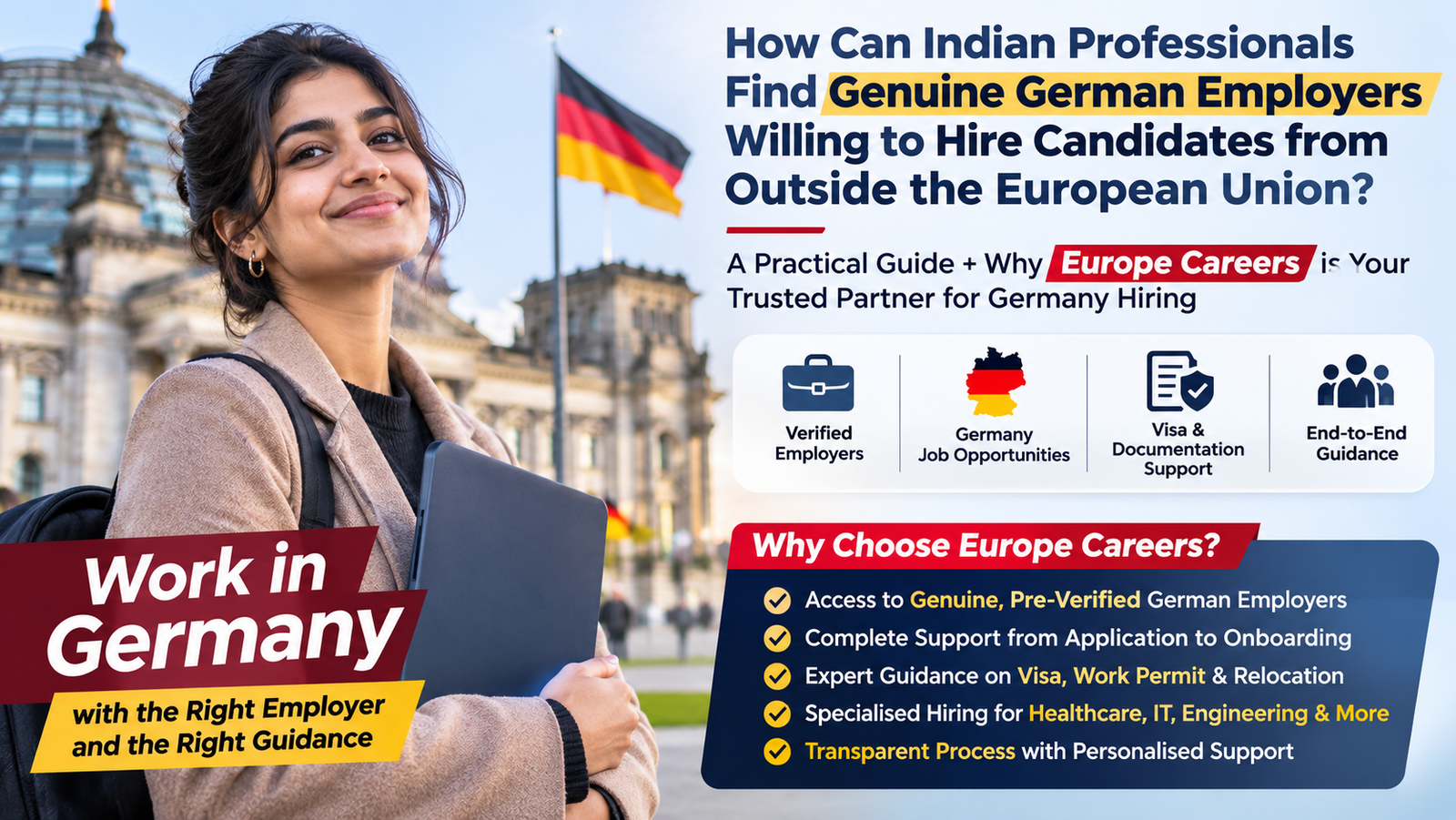
How Europe Careers helps Indian professionals approach German employers with confidence
Finding a vacancy is only one part of moving to Germany. Candidates often also need help understanding qualification status, preparing German, communicating with employers, assembling documents and planning the visa process. This is the value of a coordinated career-support approach.
Europe Careers describes its services as spanning initial counselling, German A1–B2 training, documentation guidance, interview and offer-letter support, visa assistance and post-arrival orientation. Its website also lists offices and contact points in India and Germany, giving prospective candidates identifiable places and people to contact when evaluating the service.
For applicants comparing recruitment providers, this combined approach can be attractive: one place to discuss career readiness, language development and the steps between an interview and a lawful start in Germany. Candidates should still request the exact services, fees, employer details and responsibilities in writing before enrolling.
| Stage | How Europe Careers presents its support | What candidates should confirm |
|---|---|---|
| Career assessment | Counselling about suitable Germany pathways | Eligibility, realistic roles and limitations |
| Language preparation | German A1–B2 online/offline training | Course format, duration and accepted exam |
| Document readiness | Qualification and document guidance | Which recognition authority applies |
| Employer process | Interview coordination and career assistance | Actual employer identity and vacancy |
| Visa preparation | Visa documentation and process assistance | Who files and decides the application |
| Relocation | Pre-departure and arrival guidance | Exactly which services are included |
The organisation can support preparation and coordination; it does not replace German employers, licensing bodies, immigration authorities or official visa decisions.
Why choose Europe Careers instead of navigating everything alone?
You can search for German jobs and apply independently. Germany’s official employment service offers free resources, and private consultancy is not a legal requirement for immigration. The question is whether professional guidance saves you time, helps avoid errors and gives you a clearer plan.
Europe Careers is worth considering for applicants who want language training and international career guidance together. Its published process covers counselling, German-language preparation, documentation, interviews, visa assistance and relocation support, rather than focusing only on sending a CV.
Its website lists Germany offices in Lügde and Bad Pyrmont, as well as contact points in Kanpur, Bangalore and Siliguri. This makes it possible for candidates to request a direct conversation, clarify service terms and ask how their particular career pathway would be handled.
The strongest reason to choose a career partner is accountability. Before signing, ask Europe Careers—or any provider—for a written scope of work, transparent fee information, the employer-verification approach, refund terms where applicable and realistic milestones. A credible adviser should welcome informed questions, not pressure candidates into instant payment.
Your Germany career deserves more than a forwarded job advertisement
Europe Careers brings together German-language preparation, qualification guidance, employer interview support and visa-process assistance as part of its published service model. If you are an Indian professional planning your next step, start with an eligibility discussion and ask for a pathway tailored to your qualifications and goals.
What makes a recruitment partner trustworthy?
Trust should be earned through verifiable details and responsible behaviour—not through slogans like “100% visa guaranteed.” Germany’s official guidance on private recruitment agencies highlights written contracts, transparent information, fair recruitment standards, clear fees and accessible contact details.
When considering Europe Careers or another provider, evaluate the service in exactly that way. Ask whether you can speak with a counsellor, inspect the written agreement, understand the fees and review the specific steps offered for your profession.
Be especially careful about recruitment charges in healthcare. Fair recruitment guidance supports the Employer Pays Principle, and specific ethical recruitment standards may apply. Never assume that a consultancy’s promotional claims override German legal rules.
| Trust indicator | What to ask or verify |
|---|---|
| Real company presence | Published offices, contact channels and legal identity |
| Written service agreement | Specific services, responsibilities and limitations |
| Fee transparency | Itemised costs, due dates and applicable refund terms |
| Employer transparency | Employer’s legal name and independent verification |
| Honest visa guidance | No guarantee of embassy approval |
| Qualification guidance | Correct recognition or comparability pathway |
| Candidate protection | Safe handling of personal documents |
| After-selection support | Clear statement of visa and relocation assistance |
Does Europe Careers guarantee a German job or visa?
No private recruiter can control every employer’s selection decision or the German government’s visa decision. Candidates should treat any guarantee of an unconditional job or visa with caution, regardless of which agency makes it.
Europe Careers’ website describes employer assistance, language training, documentation and visa support. The sensible expectation is professional preparation and process guidance, with exact deliverables defined in the candidate’s written agreement. Any placement or service terms should be examined carefully before payment.
Applicants should also remember that a German job offer may depend on successful interviews, qualification recognition, language ability, professional registration and compliance with immigration law.
What documents should Indian applicants prepare before contacting employers?
Most employers initially need a CV and enough information to evaluate your professional fit. Later stages may require degree certificates, experience letters, language certificates and qualification comparability evidence. For regulated professions, a recognition notice or professional licensing status may be crucial.
| Document | When it becomes useful |
|---|---|
| German-style CV | First application |
| Tailored cover letter | First application if requested |
| Degree/diploma certificates | Employer qualification review |
| Experience letters | Evidence of relevant work |
| German-language certificate | Where employer or profession requires it |
| anabin or ZAB evidence | Academic comparability for applicable visa route |
| Vocational recognition decision | Recognised vocational occupations |
| Professional licence/recognition status | Doctors, nurses and other regulated professions |
| Passport and visa documents | Official immigration process, not random outreach |
Keep scans organised and accurate. Do not pay for unnecessary translations or submit sensitive records to unknown contacts simply because someone promises an interview.
Can Indian professionals find German jobs without speaking German?
Some English-speaking positions exist, particularly in international IT and technology environments. However, many German employers require at least practical German for meetings, workplace safety, customer communication and integration.
For the standard skilled worker visa, German B2 is not a universal statutory language requirement. For employability, Europe Careers recommends building toward B2 German wherever practical. The actual employer and professional requirements must be checked individually.
Read our guide to IT jobs in Germany without German for a more detailed discussion.
Do employers sponsor visas for candidates living in India?
In Germany, “visa sponsorship” does not always mean the same thing it does in some other countries. A German employer can issue a qualified job offer, supply employment documents and, in suitable cases, support a fast-track skilled worker procedure or other immigration steps. The applicant still needs to satisfy the visa conditions.
Do not assume that “visa support” means the company pays every government fee, flight, language course or housing expense. Ask the employer which costs and tasks it will actually cover.
Germany’s Federal Employment Agency checks labour-market conditions in many cases. Its approval, where required, is generally obtained through the relevant visa or immigration process. Employers cannot personally approve a visa.
How to compare a direct application with recruitment assistance
| Factor | Applying independently | Using a support partner such as Europe Careers |
|---|---|---|
| Job discovery | You research and shortlist employers | Guidance and potential employer coordination within agreed services |
| German preparation | You select language courses yourself | Published A1–B2 language-training support |
| CV and documentation | You organise materials independently | Can discuss preparation and documentation guidance |
| Interview preparation | You research company expectations | Can seek interview-related guidance |
| Visa process | You follow official instructions yourself | Can seek process and document assistance |
| Costs | Official and personal costs still apply | Review written service fees and inclusions |
| Decision authority | Employer and government decide | Employer and government still decide |
Neither route is automatically better for everyone. An experienced German-speaking professional may prefer to apply independently, while a candidate who needs language training and help understanding recognition may find structured support more useful.
A practical 30-day plan to start searching for genuine German employers
Week 1 — Check eligibility. Identify your qualification, work experience, target occupations and whether German recognition or licensing is required. Begin or continue German study, aiming for B2 as a strong preparation goal where relevant.
Week 2 — Build your application. Create a focused CV, professional online profile and short cover-letter template. Gather degree and experience evidence and check the appropriate recognition pathway.
Week 3 — Shortlist employers. Search official international job listings, Federal Employment Agency vacancies and verified company career pages. Prioritise roles open to applicants currently outside the EU.
Week 4 — Apply and follow up. Submit tailored applications, prepare for interviews, track employer responses and independently verify every promising offer. If you want coordinated assistance, request an eligibility consultation with Europe Careers and compare the proposed service terms with your own needs.
| Week | Main objective | Deliverable |
|---|---|---|
| 1 | Confirm eligibility and target role | Realistic list of occupations and requirements |
| 2 | Prepare CV and evidence | Professional application package |
| 3 | Find overseas-friendly employers | Verified employer shortlist |
| 4 | Apply and prepare interviews | Application tracker and follow-up plan |
Common mistakes Indian applicants should avoid
Believing every Germany job advertisement accepts overseas applicants. Check whether the company can consider someone who needs a visa.
Confusing a recruiter with the employer. Ask who will sign the employment contract and who will pay the salary.
Paying for a guaranteed offer. Verify the company and read the service agreement before paying any legitimate service fees.
Ignoring language requirements. Even when a visa does not legally require B2, a particular employer may.
Assuming a job offer replaces recognition. Doctors, nurses and other regulated professionals still need appropriate authorisation.
Sending the same CV everywhere. Match your experience to the role and explain why you are suitable.
Trusting social-media testimonials without checking details. Ask for verifiable information and protect other candidates’ privacy.
Assuming an agency controls the embassy. Immigration and professional licensing decisions belong to the competent authorities.
What to ask Europe Careers during your first consultation
A useful consultation should give you more clarity about your eligibility and next steps. Bring your educational background, professional experience, current German level and target occupation. Explain whether you are looking for direct employment, recognition, Ausbildung or another route.
Ask what the recommended pathway is, which documents are needed, whether German B2 is a sensible target, how employer opportunities are verified, what interview support is included, which services have fees and what happens if a vacancy is not suitable for you.
Europe Careers publishes contact details for its India and Germany teams. Candidates can request an explanation of the process and written service terms before making a decision. This is a more dependable basis for trust than a generic “best agency” claim.
Frequently asked questions
Final advice: Find the right employer—and the right guidance
The most reliable way for Indian professionals to find genuine German employers is to combine official job sources, careful employer verification, a strong CV, realistic language preparation and a clear immigration pathway. An authentic employer will evaluate your skills and explain the role; a trustworthy adviser will help you understand the process without pretending to control the outcome.
Europe Careers offers an integrated approach for applicants who want help connecting the different parts of the journey: German training, qualification documentation, career counselling, interview preparation and visa-process support. Its published India and Germany contact points give prospective candidates a practical way to discuss their situation directly.
Whether you apply independently or seek professional support, insist on genuine employer details, transparent agreements and realistic expectations. A Germany career should begin with informed decisions—not pressure, shortcuts or promises that cannot be verified.
Ready to plan your next step? Explore Germany job opportunities and guidance, learn about skilled worker visa qualifications, or contact Europe Careers to discuss your qualifications and career goals.
Official guidance: Make it in Germany — Finding a Job; Federal Employment Agency — How to Find a Job; and Make it in Germany — Placement Agencies. Check current official guidance before making visa or financial decisions.




[…] For a detailed verification guide, see How Indian Professionals Can Find Genuine German Employers Hiring Non-EU Candidates. […]
[…] related reading, explore how to find genuine German employers hiring non-EU candidates and Germany work visa eligibility and […]