
Nursing Ausbildung in Germany for Indians: Eligibility, Salary and Application Steps

Updated November 2026 • Practical 2027 guide for Indian students and aspiring nurses
Nursing Ausbildung in Germany for Indians offers a structured route to learning professional nursing through classroom teaching and practical clinical training. Eligible students who have completed Class 12 may apply, receive a training allowance and work toward a recognised German nursing qualification after passing the required examinations.
Some German healthcare employers offer €1,400+ gross monthly from the first training year, with higher amounts in later years. For example, a German university hospital has published €1,500.70 gross per month for first-year trainees from March 2027. But salaries differ by provider, and admission requires much more than an interest in earning euros.
This guide explains nursing Ausbildung eligibility, the recommended German B2 level, school-certificate assessment, verified salary examples, training structure, visa documents, application steps and career options after graduation.
Quick overview: Training duration: normally 3 years • Entry: suitable school qualification such as an assessed Class 12 certificate • German: B2 recommended by Europe Careers, while official nursing entry rules vary between B1 and B2 • Stipend: €1,400+ possible at selected providers, not guaranteed nationwide • Visa: national vocational-training route for eligible Indian applicants.
What is nursing Ausbildung in Germany?
Nursing Ausbildung is a structured professional training programme that prepares students to become qualified nurses in Germany. The generalist programme leads to the qualification Pflegefachfrau, Pflegefachmann or Pflegefachperson. It combines theoretical education at a nursing school with supervised practice in hospitals, long-term care facilities and community nursing services.
The full-time programme normally takes three years. Trainees learn how to assess patient needs, plan care, communicate with patients and relatives, document treatment, prevent infection and respond appropriately in demanding clinical situations. Unlike a short caregiver course, generalist nursing Ausbildung is designed to lead to a regulated professional nursing qualification after the state examination and other applicable requirements are satisfied.
For Indian students who enjoy biology, healthcare and helping people, this can be a meaningful career pathway. However, it also involves early shifts, physical work, emotional resilience and regular examinations. Choosing nursing only because the training allowance is attractive can lead to disappointment if the daily responsibilities are not a good fit.
Can Indian students apply for nursing Ausbildung after 12th?
Yes. Indian students who completed Class 12 can apply for suitable nursing Ausbildung programmes, subject to the German school’s assessment of their educational qualifications and the employer’s admission criteria. Germany’s Nursing Professions Act sets out school-entry routes including a recognised intermediate school certificate or another equivalent qualification, and certain other qualifying educational pathways.
Because an Indian Class 12 certificate is a foreign qualification, applicants should not assume that every school will automatically accept it without review. The relevant German state authority or training institution may require a school-certificate assessment, certified translations or additional documents. The requirements can vary by federal state and training provider.
A Science background with Biology can be useful, but a universal rule that every nursing applicant must have studied PCB in India should not be assumed. The nursing school evaluates the actual education record, language and suitability. Students from other streams should ask the school directly whether their qualification is acceptable.
Nursing Ausbildung eligibility for Indian applicants
| Requirement | What to prepare |
|---|---|
| School education | Class 12 documents and any required German equivalence assessment |
| German language | B2 recommended by Europe Careers; B1 or B2 may be required depending on state and institution |
| Training offer | Genuine contract or confirmed training place with approved provider |
| Medical fitness | Health certificate demonstrating suitability for nursing duties |
| Good conduct | Police clearance or equivalent reliability evidence as required |
| Motivation | Interest in patient care, teamwork and responsible clinical work |
| Financial evidence | Training allowance and any additional funds needed for visa |
| National visa | Appropriate vocational-training visa for Indian citizens |
Eligibility is determined by the actual training provider, competent authorities and immigration rules. There is no legitimate guarantee of acceptance based only on passing Class 12 or purchasing a placement package.
German B2: Recommended preparation for nursing trainees
Europe Careers recommends German B2 as the minimum preparation target for Indian students planning nursing Ausbildung. Nursing is a communication-intensive profession: trainees must understand patient symptoms, medication instructions, care plans, clinical handovers, emergency conversations and classroom teaching. These tasks become considerably harder if a student can only manage memorised phrases.
Official German guidance explains that nursing training entry may require B1 or B2 depending on the federal state. Some individual employers accept B1 initially while expecting progression to B2 during training. Other employers explicitly require a B2 certificate before the programme begins. Therefore, B2 is a sensible Europe Careers preparation standard, but not a universal statutory visa rule.
| Level | Practical nursing relevance |
|---|---|
| A1 | Basic introductions; insufficient for clinical training |
| A2 | Simple conversation; generally below nursing training expectations |
| B1 | Can satisfy certain training-entry requirements depending on state and employer |
| B2 | Europe Careers’ recommended preparation target; useful for patient communication and coursework |
| C1 | Advanced professional fluency; beneficial for complex communication |
Students should prepare all four language skills: speaking with patients, understanding rapid spoken German, reading medical instructions and writing accurate care notes. A certificate without usable communication skills may not be enough to succeed in a real hospital environment.
Nursing Ausbildung salary: €1,400+ monthly examples
One major advantage of generalist nursing Ausbildung is that trainees normally receive a monthly training allowance. Some providers offer more than €1,400 gross from the first year. The exact amount depends on the employer, collective agreement, region and training year. It is important to distinguish gross monthly pay from net money available after deductions.
For example, the TUM University Hospital published the following training pay for March 2027 under its applicable collective agreement:
| Training year | Gross monthly stipend from March 2027 |
|---|---|
| First year | €1,500.70 |
| Second year | €1,566.70 |
| Third year | €1,673.00 |
These figures are an actual employer example, not a nationwide guaranteed stipend. Other providers may pay less or more, and some include separate allowances for shifts or other duties. An advertised €1,400+ starting stipend should always be verified in the training contract.
Another 2027 nursing training advertisement listed a first-year amount of €1,490.69, with increases in later years. This illustrates why students should compare individual employers instead of relying on a single general salary promise.
Before accepting an offer, ask for the gross amount for each year, estimated net pay, paid leave, work schedule, any shift allowances and whether accommodation or transport support is included. Rent in a large city can significantly affect how much money remains each month.
What will you learn during the three-year nursing programme?
Generalist nursing Ausbildung combines classroom instruction with practical rotations. Students learn anatomy, physiology, hygiene, infection prevention, patient observation, communication, ethics, care planning, documentation, medication-related responsibilities and safe handling of medical equipment under supervision.
Clinical placements expose trainees to different patient groups. These may include acute hospital wards, long-term care, ambulatory services, paediatrics and mental health settings. This variety helps students understand the broad responsibilities of qualified nurses before choosing a later specialisation.
| Training component | Typical content |
|---|---|
| Nursing theory | Health sciences, nursing processes, ethics and patient safety |
| Acute care | Supervised hospital-based nursing practice |
| Long-term care | Support for older adults and patients needing ongoing care |
| Ambulatory nursing | Care delivered outside hospitals |
| Paediatric experience | Care for children and families |
| Psychiatric experience | Communication and mental-health nursing |
| Clinical documentation | Recording observations and care accurately |
| State examination | Assessment of required professional knowledge and competence |
The generalist programme typically comprises at least 2,100 hours of theoretical and practical classroom instruction and 2,500 hours of practical training. Successful completion requires more than attendance; students must meet academic and practical assessment standards.
Practical nursing training: What the workplace is really like
A nursing trainee may start a shift by listening to a handover from the previous team, checking assigned patients, assisting with daily care, observing vital signs and documenting relevant changes. A supervisor helps the trainee understand what can be done independently and what requires oversight.
Patients may be frightened, uncomfortable or unable to explain symptoms clearly. This is why language, patience and careful listening are as important as technical ability. Nursing students also need to understand infection-control rules, confidentiality and professional boundaries.
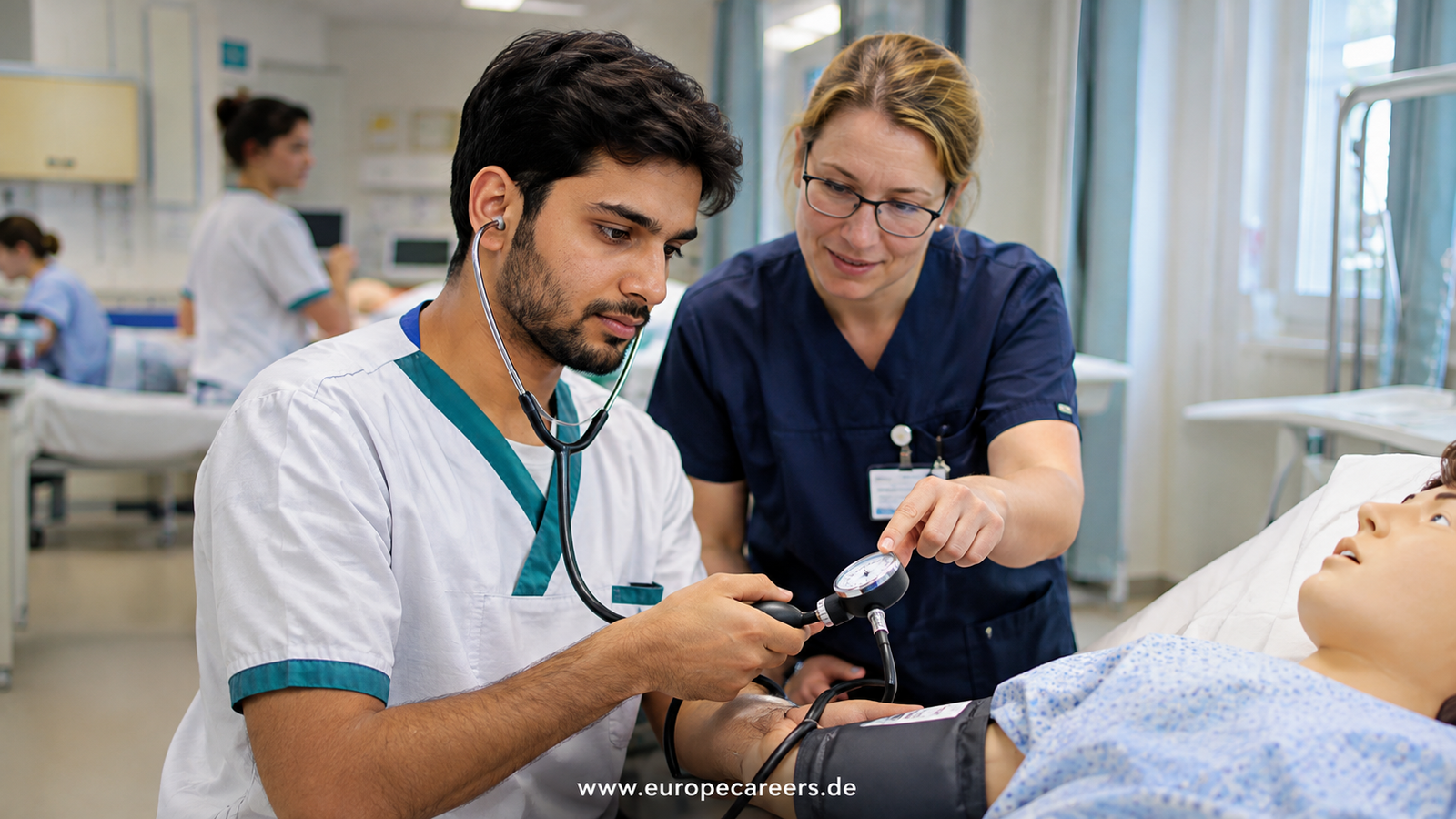
The training programme should provide structured supervision. Students are learners, not substitutes for fully qualified nurses, and they should receive tasks appropriate to their training level.
Nursing Ausbildung salary versus living expenses
Receiving a training allowance does not mean the full amount can be saved. Gross pay is reduced by applicable social insurance contributions and possibly tax. Living expenses depend heavily on the city, housing arrangement and personal spending.
| Expense | Questions to ask before relocation |
|---|---|
| Rent and deposit | Does the employer offer accommodation? Is it shared? |
| Food | What is a realistic monthly grocery budget? |
| Local transport | Is a transport ticket subsidised? |
| Health insurance | What deductions and coverage apply? |
| Phone and essentials | What are the regular personal costs? |
| Emergency savings | Can you cover an unexpected expense or payroll delay? |
Applicants should compare estimated net pay with their actual housing costs rather than converting a gross euro salary directly into Indian rupees. Financial stability during training is more important than an impressive headline stipend.
Nursing Ausbildung visa requirements for Indian students
Indian citizens generally need a German national visa for vocational training under Section 16a of the Residence Act. A confirmed training place is central to the standard application. Applicants must also demonstrate that their living expenses are secured and provide the relevant education, language, identity and insurance documents.
Where the training allowance does not satisfy the applicable financing benchmark, additional accepted funds may be required. Visa financial thresholds can change, so applicants should check the current figure when applying rather than relying on an older blog post.
For nursing, the language level required by the school or competent state authority may be higher than the general visa guidance. Europe Careers recommends B2 preparation to help students meet employer expectations and perform safely in training.
A training contract is not the same as a visa approval. The German mission and relevant immigration authorities assess each application.
Documents required for nursing Ausbildung
| Document | Why it matters |
|---|---|
| Passport | Identity and national visa processing |
| Class 10 and Class 12 certificates | Educational background and school-entry assessment |
| German language certificate | Proof of the required B1/B2 level |
| Training contract | Confirmed nursing Ausbildung placement |
| CV | Education, relevant experience and language history |
| Motivation letter | Reasons for choosing nursing and the training provider |
| Health fitness certificate | Suitability for patient-care duties |
| Police clearance / conduct evidence | Reliability requirements |
| Financial evidence | Living-cost support where required |
| Insurance evidence | Coverage during entry and training |
| Translations / recognition | Where required for Indian school documents |
The exact document list depends on the German mission, state and training provider. Use the latest application checklist and provide accurate, consistent records. Never submit fabricated language certificates or work history.
How to apply for nursing Ausbildung from India
| Application stage | What to do | Important advice |
|---|---|---|
| Check suitability | Understand nursing duties and training conditions | Do not choose solely for salary |
| Complete school education | Prepare Class 10/12 documents | Check German school-certificate equivalence |
| Learn German | Aim for B2 before applying | Practise clinical communication |
| Research providers | Identify genuine hospitals, care groups and nursing schools | Verify the employer and programme |
| Prepare CV and letter | Explain motivation and relevant skills | Avoid generic copied applications |
| Attend interview | Discuss language, teamwork and care scenarios | Answer honestly and clearly |
| Review training contract | Check salary, duration, school and work location | Request all terms in writing |
| Prepare visa documents | Collect recognition, health and financial evidence | Follow current official checklist |
| Apply for national visa | Use the applicable German visa procedure | Do not book non-refundable travel prematurely |
| Plan relocation | Arrange housing and initial funds | Prepare for first weeks in Germany |
| Start Ausbildung | Attend theory, placements and assessments | Build language and practical skills continuously |
Nursing Ausbildung interview preparation
Employers may ask why you want to become a nurse, what you know about patient care, how you would handle an upset patient and whether you are prepared for shift work. They may also test everyday German conversation to judge whether you can understand instructions and communicate respectfully.
A useful response to “Why nursing?” should connect your interest in healthcare with realistic understanding of the profession. For example, you might explain that you value supporting people during illness, are comfortable learning practical skills and understand that nursing involves teamwork and responsibility.
Prepare examples from school, volunteering or family responsibilities, but do not invent hospital experience. Practise speaking naturally in German rather than memorising a script you cannot adapt when the interviewer asks a follow-up question.
Can boys and girls both apply for nursing Ausbildung?
Yes. Nursing Ausbildung is open to eligible men and women. Applicants are assessed on educational suitability, language, health and the requirements of the training programme. The occupation includes diverse clinical responsibilities and is not restricted to one gender.
Students should focus on selecting a suitable provider, developing communication skills and understanding the practical expectations of patient care.
Is there an age limit for nursing Ausbildung?
There is no single universal maximum age for starting nursing Ausbildung. Individual providers may have programme-specific expectations, and immigration requirements still apply. Some employers specify a minimum age for their training intake.
Do not confuse a visa for an existing training place with the separate visa for searching for a training place, which has its own age and eligibility conditions. Students should review the route they are actually using.
What happens after completing nursing Ausbildung?
After completing the required programme and passing the state examination, graduates can pursue the relevant professional authorisation and qualified nursing employment. The generalist qualification is designed for a broad range of care settings, including hospitals, long-term care and ambulatory services.
Graduates may later specialise in intensive care, emergency nursing, geriatric care, education or management through additional training and experience. Some continue with university study in nursing sciences or healthcare management.
Finishing Ausbildung does not automatically guarantee a job, permanent residence or unrestricted work permission. Graduates must meet the requirements of any subsequent employment and residence title.
Nursing Ausbildung versus applying as an already qualified Indian nurse
| Question | Nursing Ausbildung | Qualified Indian nurse recognition |
|---|---|---|
| Starting background | Eligible school-leaver or other accepted applicant | Existing Indian nursing qualification |
| Main process | Three-year German nursing training | Assessment of foreign nursing qualification |
| Professional outcome | German nursing qualification after successful completion | German recognition/authorisation after required steps |
| Language | B1/B2 entry depending on state; B2 recommended | Typically professional B2 requirements, depending on authority |
| Pay during process | Training allowance | Depends on employment and recognition arrangement |
| Best suited to | Students seeking initial nursing qualification | GNM/BSc nurses with existing credentials |
Indian nurses who already hold a nursing qualification should compare the recognition pathway before committing to a full three-year Ausbildung. Repeating training may not be the most suitable or efficient option in every case.
Common mistakes to avoid
Believing every nursing stipend starts at €1,400: Some employers offer that amount or more, but payment depends on the actual provider and collective agreement.
Ignoring B2 preparation: Even where B1 is accepted for entry, a higher level of German can make patient communication and classroom learning substantially easier.
Assuming Class 12 guarantees admission: The training school may need to assess your school qualification, and employers conduct interviews and suitability checks.
Paying for guaranteed visas: No recruiter can guarantee a German visa or a professional nursing qualification.
Confusing caregiver training with generalist nursing: Shorter nursing assistant programmes are not the same as the three-year generalist nursing qualification and may have different salaries and career rights.
Overlooking living costs: The actual net training allowance, rent and initial relocation costs should be understood before travel.
Frequently asked questions about nursing Ausbildung
Can Indian students apply for nursing Ausbildung after 12th?
Yes, if their school qualification meets the relevant admission requirements and they secure a suitable training place.
What is the minimum German language level?
Nursing training can require B1 or B2 depending on the state and employer. Europe Careers recommends preparing to B2 before departure.
Does nursing Ausbildung pay €1,400 per month?
Some providers pay over €1,400 gross monthly from year one. For example, TUM University Hospital lists €1,500.70 from March 2027. Other employers may pay differently.
How long is nursing Ausbildung?
Full-time generalist nursing Ausbildung normally takes three years.
Is nursing Ausbildung free?
Generalist nursing Ausbildung is normally financed through the training system, and trainees receive remuneration. Living, relocation and personal expenses still need planning.
Can male Indian students apply?
Yes. Eligible men and women can apply.
Is Biology compulsory in Class 12?
Not as a universal rule for every German nursing school. The school and competent authority assess the applicant’s qualifications.
Do I need IELTS?
German nursing Ausbildung is generally taught in German. IELTS is not a universal requirement for this pathway; German-language evidence is usually much more relevant.
Do I need a blocked account?
It depends on whether the training allowance and other accepted evidence meet the applicable visa livelihood requirement.
Is there an age limit?
No single universal maximum age applies to starting nursing Ausbildung, although provider and visa conditions may differ.
Can I work in a hospital after training?
Eligible graduates who complete training and obtain the required professional authorisation can pursue qualified nursing employment.
Is a job guaranteed after Ausbildung?
No. Opportunities depend on qualification completion, authorisation, available positions and residence eligibility.
Can an Indian BSc nurse apply?
Yes, but an existing qualified nurse should first investigate recognition of the Indian qualification, which may be more suitable than starting a new three-year programme.
Final thoughts: Plan nursing Ausbildung with realistic expectations
Nursing Ausbildung can offer Indian students a structured path into Germany’s healthcare system, combining practical education, a monthly allowance and a recognised qualification. It is particularly relevant for students who genuinely want to work with patients and are willing to invest time in German-language preparation.
Europe Careers recommends B2 German before departure wherever possible. Compare verified training offers, check school-certificate acceptance, examine gross and net pay and prepare the correct visa documents. The most attractive salary advertisement is not necessarily the best training environment.
Explore Ausbildung in Germany for Indian Students, Ausbildung After 12th and Nursing Jobs in Germany for Indian Nurses. For guidance on language preparation and career pathways, contact Europe Careers. Final admission, professional authorisation and visa decisions rest with the responsible institutions and authorities.


[…] For the student pathway, see our Nursing Ausbildung in Germany guide. […]